Chapter 8. Bernardus Saey and Marie Therese Vervaet, on the Landsdijk, 1803 to 1870
The eldest son
Bernardus, the eldest son of Judocus Bernardus, was born at Bassevelde on 25 April 1803, in the Kraeygemstraat, under the French Republic. The birth act of chapter 7 is his.1 He grew up a Bassevelde boy with two younger brothers, Jean François and Ange, later Engelbertus. He was seventeen when his mother died in March 1821, and eighteen when his father married again, to a woman less than five years older than himself. He was twenty-eight when his father died, in September 1831, in the first months of the kingdom of Belgium.2
For another ten years we lose sight of him. When he appears again, in 1842, he is thirty-eight and about to be married.
Marie Therese from Zelzate
His bride was Marie Therese Vervaet, from Zelzate, a village on the canal from Ghent to Terneuzen, about ten kilometres east of Bassevelde. She had been born there at four in the morning of 15 October 1813, when Zelzate was still a commune of the French department of the Scheldt. Her father, Jean Baptiste Vervaet, was a weaver, forty-three years old, born at Ertvelde. Her mother, Livine Marie Vermeire, came from Evergem, the parish next to Sleidinge that had given the family a bride two generations before.3
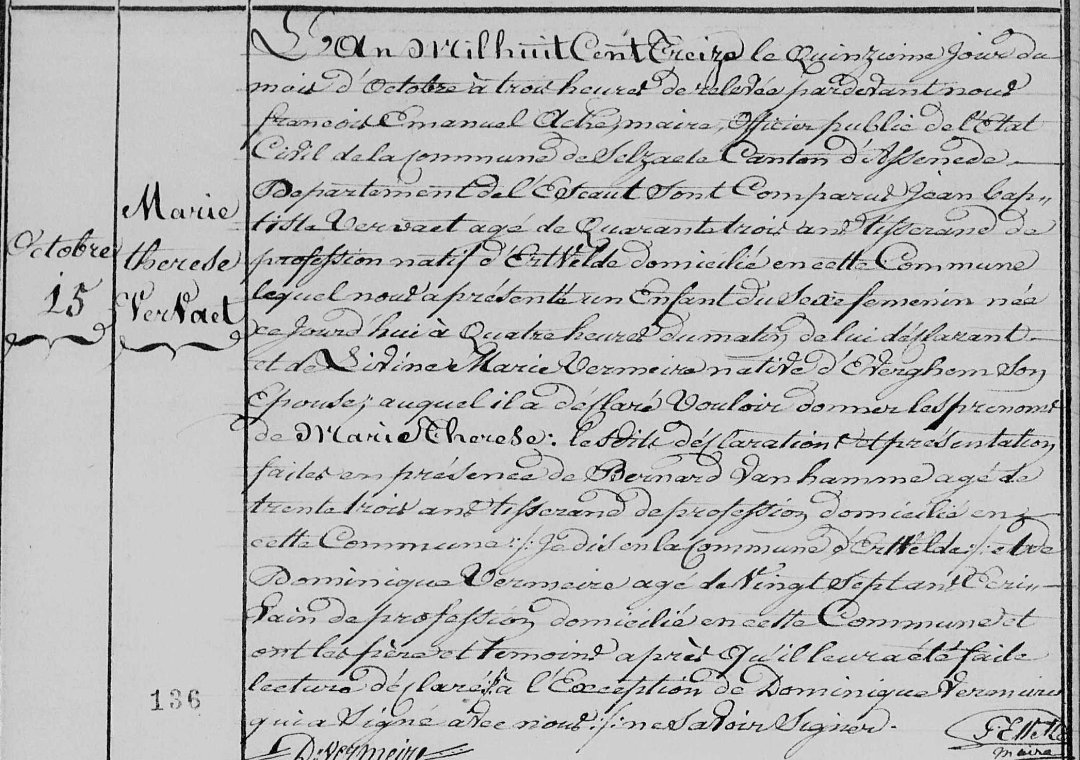
Transcription and translation
L'an mil huit cent treize le quinzième jour du mois d'octobre à trois heures de relevée pardevant nous François Emanuel Ache [?], maire, officier public de l'état civil de la commune de Selzaete, canton d'Assenede, Département de l'Escaut, sont comparus Jean Baptiste Vervaet âgé de quarante trois ans, tisserand de profession, natif d'Ertvelde, domicilié en cette commune, lequel nous a présenté un enfant du sexe féminin né ce jourd'hui à quatre heures du matin de lui déclarant et de Livine Marie Vermeire native d'Everghem son épouse, auquel il a déclaré vouloir donner les prénoms de Marie Therese ... et ont le père et témoin, après qu'il leur a été fait lecture, déclaré, à l'exception de Dominique Vermeire qui a signé avec nous, ne savoir signer.
On 15 October 1813 at three in the afternoon, before François Emanuel Ache [?], mayor of Zelzate, canton of Assenede, department of the Scheldt, appeared Jean Baptiste Vervaet, aged 43, a weaver, born at Ertvelde, living here. He presented a girl born today at four in the morning to him and to Livine Marie Vermeire, born at Evergem, his wife, and named her Marie Therese ... The father and one witness declared that they could not sign; the other witness, Dominique Vermeire, signed with the mayor.
The act was written in French. It ends, like so many in this history, with a note that the father could not sign. Only one witness, a young clerk named Dominique Vermeire, could.3
Bernardus and Marie Therese were married at Zelzate on 23 February 1842. He was thirty-eight and she twenty-eight.4 It was a year of borders. Belgium had been recognised by the Netherlands in 1839, and on 5 November 1842 the two kingdoms signed the treaty that fixed the line between them, completed the next year at Maastricht.5 The new frontier followed the old one through the Four Ambachten. A few kilometres north of the Landsdijk, the fields of Bassevelde and Boekhoute now ended at a state border, and beyond it lay Dutch Zeeland.
The dyke
The couple made their home on the Landsdijk, north of the village. The name is exact: it is a dyke, and they lived on top of it. The Landsdijk is part of the Graaf Jansdijk, a sea dyke probably built at the end of the thirteenth century and raised about 1400, and what it was built to hold back was the Braakman, the sea inlet that had drowned fifteen villages and still came inland as far as Boekhoute and Philippine, which were ports on it.6 By Bernardus's day later reclamation had left the dyke inland, a raised road through the polders, and the sea was a few kilometres further off than it had been. With the strong growth of the population in the nineteenth century it became a busy polder hamlet of its own. In 1897 the Bernardine sisters opened a school and a small convent there, and in time the hamlet became a parish.6
Their son Eduardus was born in 1844 or 1845. His birth act has not yet been found: he was thirty-three when he married in August 1878, which puts his birth between August 1844 and August 1845.7 A daughter, Amelia, followed at five in the morning of 24 August 1848, and her birth act is the only record in this history that gives the family's address with a number.
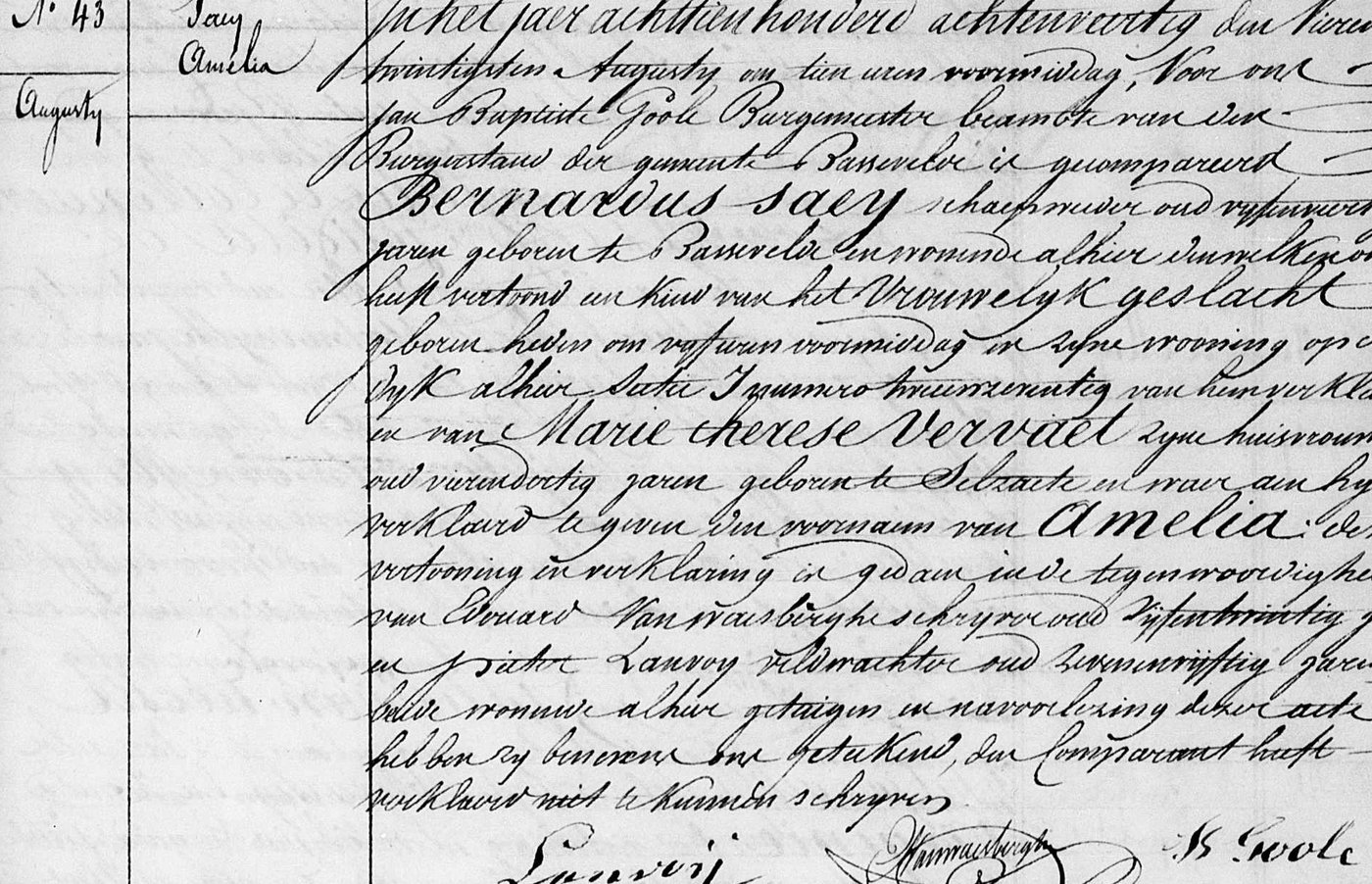
Transcription and translation
In het jaer achttienhonderd achtenveertig den vierentwintigsten Augusty om tien uren voormiddag, voor ons Jan Baptiste Goole Burgemeester beambte van den Burgerstand der gemeente Basseveld is gecompareerd Bernardus Saey schaepweider [?] oud vyfenveertig jaren geboren te Basseveld en wonende alhier, dewelke ons heeft vertoond een kind van het vrouwelyk geslacht geboren heden om vyf uren voormiddag in zyne wooning op den Dyk alhier Sectie J nummero twee en zeventig van hem verklaerder en van Marie Therese Vervaet zyne huisvrouw oud vierendertig jaren geboren te Selzaete, en waer aen hy verklaerd te geven den voornaem van Amelia ... den comparant heeft verklaerd niet te kunnen schryven.
On 24 August 1848 at ten in the morning, before Jan Baptiste Goole, mayor of Bassevelde, appeared Bernardus Saey, sheep herder [?], aged 45, born at Bassevelde and living here. He presented a girl born today at five in the morning in his house on the Dyk here, section J number 72, to him and to Marie Therese Vervaet, his wife, aged 34, born at Zelzate, and named her Amelia ... The father declared that he could not write.
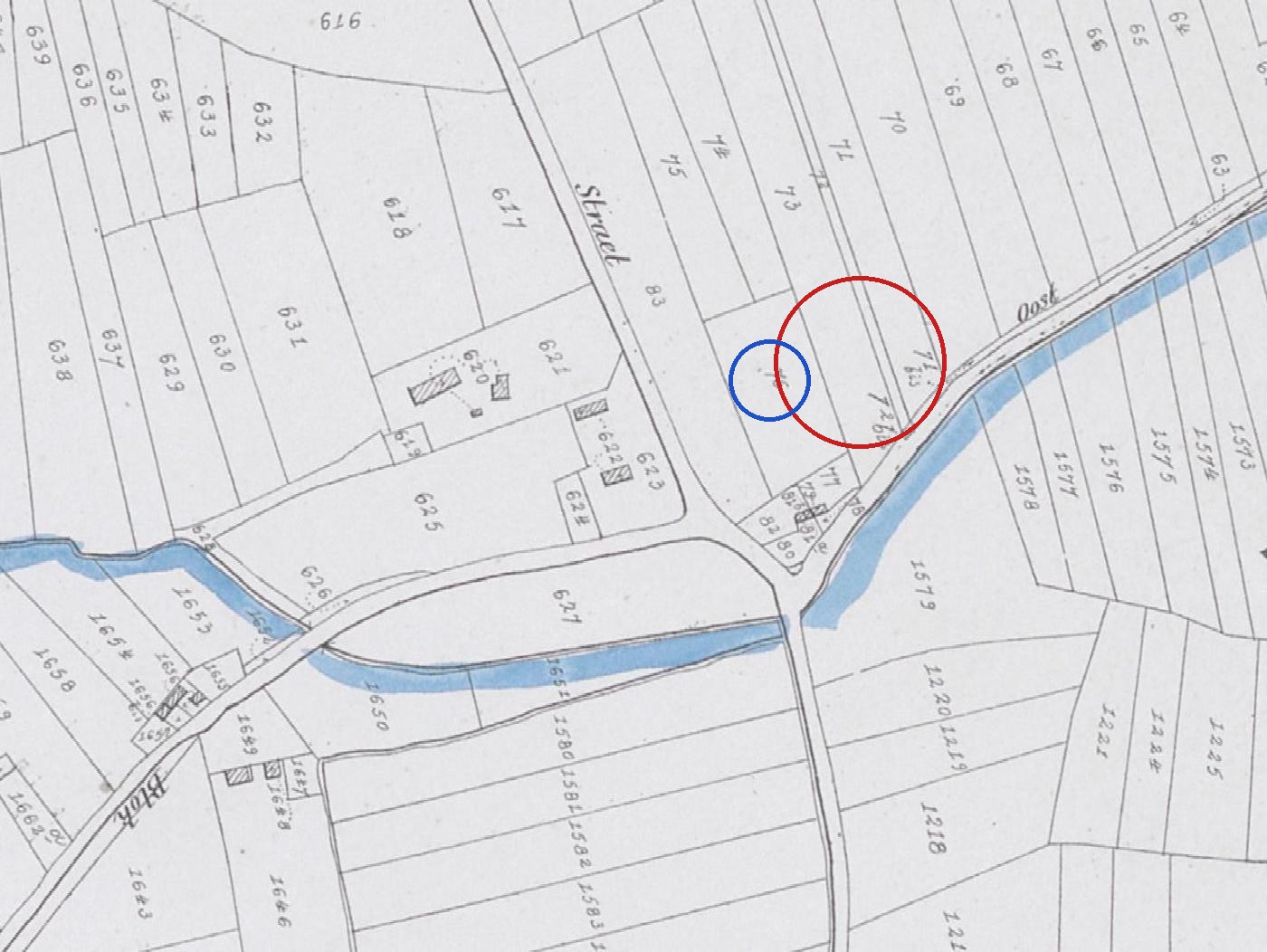
Bernardus, forty-five, described perhaps as a schaepweider, a shepherd, came to the mayor that same morning.8 The child had been born in zyne wooning op den Dyk alhier, Sectie J nummero twee en zeventig: "in his house on the Dyk here, section J, number seventy-two." The clerk seems to have given the address in the terms of the land register, the cadastre, with a section letter and a parcel number. The next entry in the register, ten days later, is for the daughter of a neighbour, the farm labourer Jacobus van Waes, born op den Dyk alhier, Sectie J nummero zesenzeventig: on the Dyk, section J, number 76.9
The Popp cadastral map of Bassevelde, drawn in the middle of the nineteenth century, shows the land parcel by parcel, with their numbers. In section J, beside a road junction by the canal, parcels 72 and 72bis and parcel 76 lie next to each other, about a kilometre and a half north-west of the village church. The modern street that passes the spot is still called the Landsdijk. It is probably the place where Amelia was born, and where Eduardus grew up.10
The act ends: den comparant heeft verklaerd niet te kunnen schryven, "the declarant stated that he could not write." His father Judocus had signed Bernardus's own birth act in 1803. Bernardus never learned.8
The hungry forties
Amelia was born into the worst years that nineteenth-century Flanders knew. The spinning of flax yarn by hand, the work of some 220,000 spinners in their cottages, had already been ruined by British machine spinning around 1830. Then, in the summer of 1845, a fungal disease appeared in the potato fields near Kortrijk. Between 1845 and 1847 it destroyed the potato crops of north-west Europe. Hunger brought typhus and cholera with it. An estimated 44,000 people died of hunger and disease in Belgium in those three years, some 30,000 of them in East and West Flanders. In the decades that followed, Flemings left in growing numbers, first for France, and from the 1870s by ship from Antwerp to New York.11
What these years meant for the house on the dyke the records do not say. The family were labourers: Bernardus worked for others, and Marie Therese worked on the land. They came through.
Deaths on the dyke
Bernardus died at one o'clock in the night of 13 November 1861, in the Landsdyk quarter of Bassevelde, aged fifty-eight. His son Eduardus was about sixteen, and Amelia thirteen. It was not the family who reported the death, but two men described as acquaintances of the dead man: the municipal secretary, Ivo Haers, and a shoemaker.12
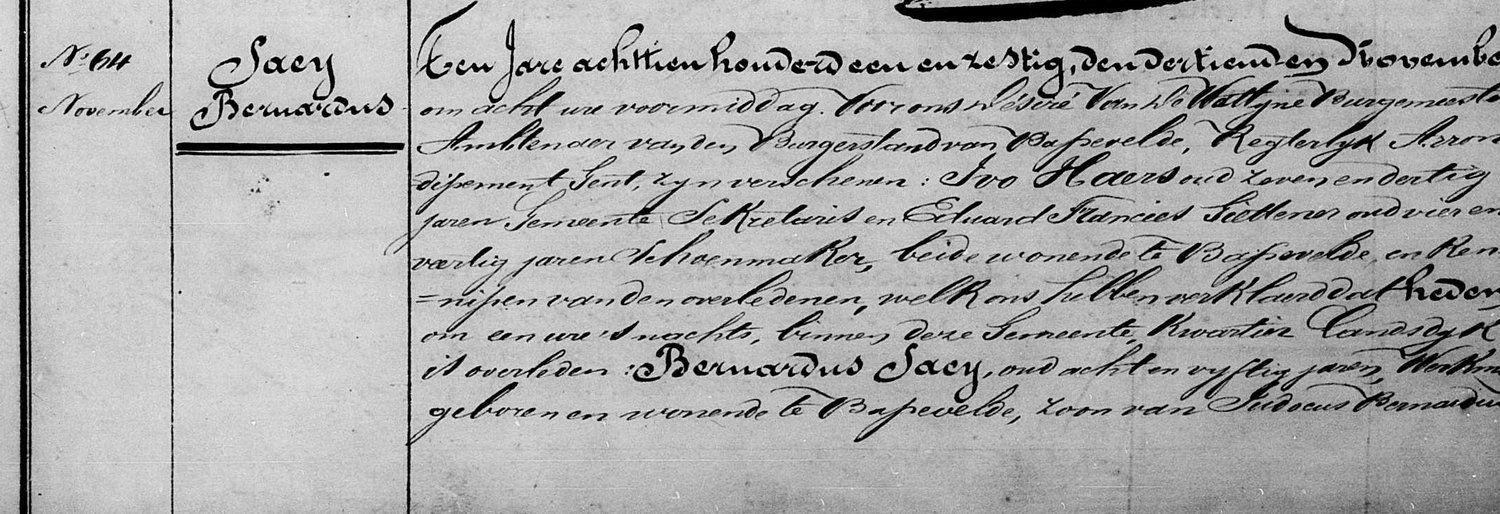
Transcription and translation
In Jare achttien honderd een en zestig, den dertienden November om acht ure voormiddag. Voor ons Désiré Van de Wattyne Burgemeester Ambtenaer van den Burgerstand van Bassevelde, Regterlyk Arrondissement Gent, zyn verschenen: Ivo Haers oud zeven en dertig jaren Gemeente Sekretaris en Eduard Francies Guttener oud vier en veertig jaren schoenmaker, beide wonende te Bassevelde, en kennissen van den overledenen, welke ons hebben verklaerd dat heden om een ure 's nachts, binnen deze Gemeente, Kwartier Landsdyk is overleden: Bernardus Saey, oud acht en vyftig jaren, Werkman [?], geboren en wonende te Bassevelde, zoon van Judocus Bernardus [continues on the next page]
On 13 November 1861 at eight in the morning, before Désiré Van de Wattyne, mayor of Bassevelde, judicial district of Ghent, appeared Ivo Haers, 37, municipal secretary, and Eduard Francies Guttener, 44, shoemaker, both of Bassevelde and acquaintances of the deceased. They declared that today at one o'clock in the night, in this commune, in the Landsdyk quarter, died Bernardus Saey, aged 58, labourer [?], born and living at Bassevelde, son of Judocus Bernardus [the act continues on the next page, which we do not have].
Marie Therese lived nine years longer, as a widow and a farm labourer on the dyke. She died at ten in the evening of 3 September 1870, in what the act calls the hamlet of Landdyk. The next morning two men went to the mayor: her son, Eduard Saey, dienstknecht, a farm servant, and his uncle, Engelbertus Saey, a farm labourer, Bernardus's youngest brother.13
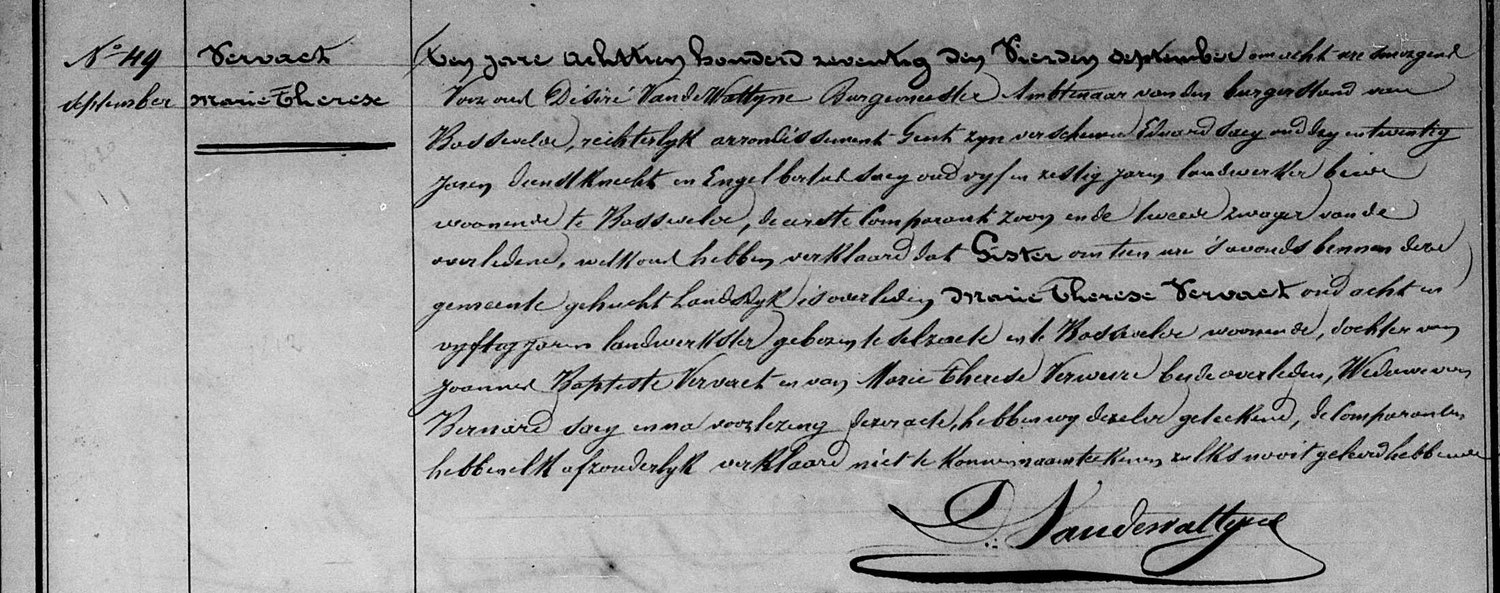
Transcription and translation
In Jare achttienhonderd zeventig den vierden September om acht ure 's morgens voor ons Désiré Van de Wattyne Burgemeester Ambtenaar van den burgerstand van Bassevelde, rechterlyk arrondissement Gent zyn verschenen Eduard Saey oud dry [?] en twintig jaren dienstknecht en Engelbertus Saey oud vyf en zestig jaren landwerker, beide wonende te Bassevelde, de eerste comparant zoon en de tweede zwager van de overledene, welke ons hebben verklaard dat gister om tien ure 's avonds binnen deze gemeente gehucht Landdyk is overleden Marie Therese Vervaet oud acht en vyftig jaren landwerkster geboren te Selzaete en te Bassevelde woonende, dochter van Joannes Baptiste Vervaet en van Marie Therese Verweire [?] beide overleden, weduwe van Bernard Saey; en na voorlezing dezer acte hebben wy dezelve geteekend, de comparanten hebben elk afzonderlyk verklaard niet te kunnen naamteekenen, zulks nooit geleerd hebbende.
On 4 September 1870 at eight in the morning, before Désiré Van de Wattyne, mayor of Bassevelde, appeared Eduard Saey, aged 2[?], farm servant, and Engelbertus Saey, aged 65, farm labourer, both of Bassevelde, the first the son and the second the brother-in-law of the deceased. They declared that yesterday at ten in the evening, in the hamlet of Landdyk, died Marie Therese Vervaet, aged 58, farm labourer, born at Zelzate and living at Bassevelde, daughter of Joannes Baptiste Vervaet and Marie Therese Verweire [?], both deceased, widow of Bernard Saey. The declarants each said that they could not sign their names, never having learned.
The act gives her age as fifty-eight, two years more than she was, and it ends with a sentence that sums up three generations: de comparanten hebben elk afzonderlyk verklaard niet te kunnen naamteekenen, zulks nooit geleerd hebbende, "the declarants each stated that they could not sign their names, never having learned."13 Judocus Bernardus had signed every act he appeared in. His sons Bernardus and Engelbertus, and his grandson Eduard, could not write their names.
Amelia
Amelia stayed at Bassevelde. In 1880, a labouring woman of thirty-one, she married Victorinus Amandus Dumonsau, a labourer from Kaprijke. At the wedding she declared under oath that she could not produce proof of where her grandparents on either side had died, a formula the clerks used in place of the grandparents' death certificates.14 She could not sign her name.
By then her brother was gone. Some time in the 1870s Eduardus crossed the border to work in Zeeland, and in 1878 he married at IJzendijke.15 His story, and the family's life in the Netherlands, is the subject of the next part.
-
Birth of Bernardus Saey, Bassevelde, act 180, 6 Floréal year XI [S57]. Read from the image (grade A). FamilySearch and the family trees give 24 April 1802, which the act rules out. ↩
-
Death of Anna Marie Bolangiers, 8 March 1821, and second marriage of Judocus Bernardus, 30 November 1821 [S49]; death of Judocus Bernardus, 21 September 1831, stated in the marriage of Engelbertus, 1832 [S57] (grade A for the statements). ↩
-
Birth of Marie Therese Vervaet, Zelzate, act 136, 15 October 1813 [S58]. Read from the image (grade A). The distance is measured on a modern map. ↩↩
-
FamilySearch, "Marriage Registration" event for Bernardus Saeij and Marie Therese Vervaet, Zelzate, 23 February 1842 [S59] (grade B). The marriage act itself has not been read. Their ages are derived from their births (grade C). ↩
-
Treaty of London (1839), Wikipedia [S54]; Borders of Belgium, Wikipedia [S53]. ↩
-
C. Bogaert and K. Lanclus, Landsdijk, Inventaris Onroerend Erfgoed (2005) [S56]. ↩↩
-
Marriage of Eduardus Saey, IJzendijke, act 15, 17 August 1878: "aged thirty-three, born at Bassevelde, Belgium" [S58] (grade A for the age; the birth year is derived, grade C). A birth act of June 1845 filed in the family's folder under his name is in fact that of Angeline, daughter of a different Eduardus Saey; see chapter 9. ↩
-
Birth of Amelia Saey, Bassevelde, act 43, 24 August 1848 [S58]. Read from the image (grade A). The father's trade is hard to read; schaepweider (shepherd) is the likeliest reading. ↩↩
-
Same register page, act 44, 3 September 1848: Melanie, daughter of Jacobus van Waes, farm labourer, aged 36, born at Kaprijke [S58] (grade A). He is not the butcher Jacobus van Waes, aged 39 in 1821, who witnessed the marriage of that year. ↩
-
Popp cadastral map, Bassevelde, section J, from the Flemish historical-maps service [S20]; view cut on 21 September 2026 (
records/fetch_maps.py). The street name at the junction from OpenStreetMap. That "section J number 72" in the 1848 act means cadastral parcel 72 is our reading (grade C). It is supported by the neighbour's "number 76" falling on the adjoining parcel. The Popp map of Bassevelde may date from some years after 1848, and parcels were sometimes renumbered. ↩ -
Death of Bernardus Saey, Bassevelde, act 64, 13 November 1861 [S58]. Read from the image (grade A), first page only; the continuation, with the parents' names in full, is not in the family's folder. ↩
-
Death of Marie Therese Vervaet, Bassevelde, act 49, 4 September 1870 [S57] (grade A). Her age of 58 conflicts with her birth in October 1813 (she was 56). ↩↩
-
Marriage of Victorinus Amandus Dumonsau [?] and Amelia Saey, Bassevelde, act 10, May 1880 [S58]. Read from the image (grade A); the groom's surname and the day of the month are uncertain. ↩
-
Marriage of Eduardus Saey, IJzendijke, 17 August 1878: "now living at IJzendijke, formerly at Waterlandkerkje" [S58] (grade A). ↩