Part Two. Towards the border
Chapter 6. Bernardus Saeij and Maria Anna van Hijfte, 1748 to 1809
The last Sleidinge generation
Bernardus was born at Sleidinge in January 1748, while the French held Flanders, and was baptised twice on the day of his birth, as chapter 3 told. He was the only one of Joannes and Georgia's five sons whose later life the records follow. He lost his father in January 1767, when he was eighteen, and his mother in December 1770.1 By then he was married, and he was a father himself.
His bride was Maria Anna van Hijfte, a girl from Evergem, the next parish, a few kilometres to the south-east. They were betrothed in her parish church on 26 December 1768, in the week after Christmas, before two witnesses: Georgius van Hecke and Isabella van Hijfte, one of her own family. The three banns were read on the three Sundays that followed, and on 7 January 1769 the parish priest of Evergem, Dominicus van Belleghem, married them before the same two witnesses. He wrote the betrothal and the wedding into a single entry, and he spelled the groom's name in the short Evergem way, Say.2
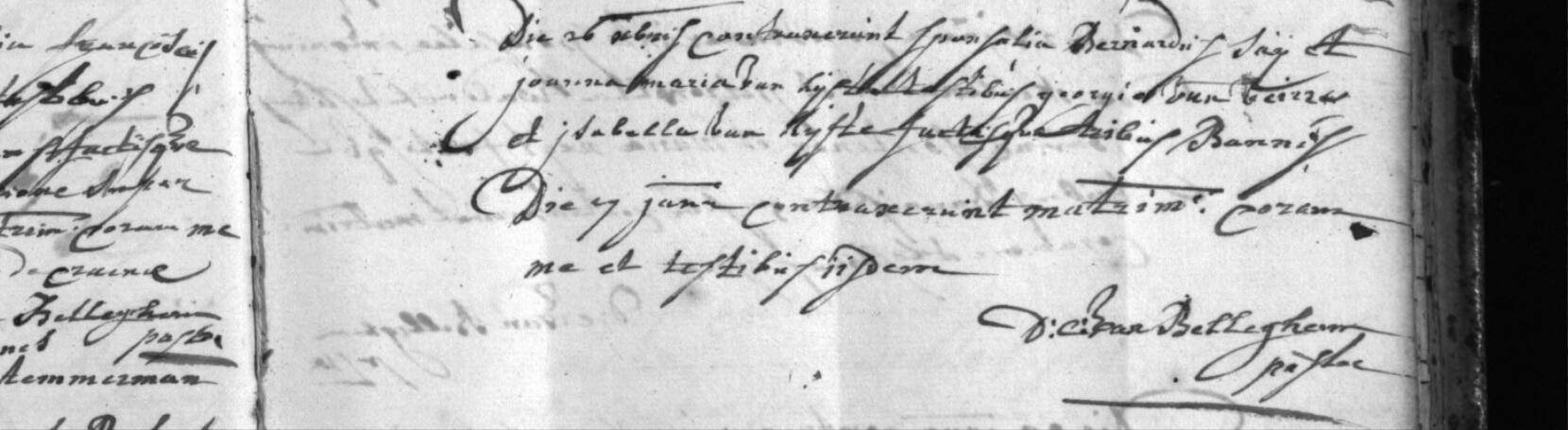
Transcription and translation
Die 26 [x]bris contraxerunt sponsalia Bernardus Say et Joanna Maria van Hijfte, testibus Georgio van Hecke et Isabella van Hijfte; factisque tribus bannis, die 7 janu[arii] contraxerunt matrim[onium] coram me et testibus iisdem. D. van Belleghem pastor.
On 26 December [1768] Bernardus Say and Joanna Maria van Hijfte were betrothed, before the witnesses Georgius van Hecke and Isabella van Hijfte; and when the three banns had been read, on 7 January [1769] they were married before me and the same witnesses. D. van Belleghem, parish priest.
Maria Anna's first name wanders through the records in a way that would puzzle anyone looking for her: she is Joanna Maria, Anna Maria and Maria at the baptisms of her children, Marie in 1800, Joanna Marie in 1802 and Anne Marie in 1821.3 Two baptisms at Evergem could be hers. One is that of a Joanna Maria van Hifte, baptised on 24 April 1749. The other is on page 57 of the Evergem baptismal register, under the heading Septembris: Marianna, born at about five in the morning of 5 September 1750 and carried to the font the next day. Her godmother was another Marianna van Hijfte; the godfather's name has gone with the torn corner of the page.4
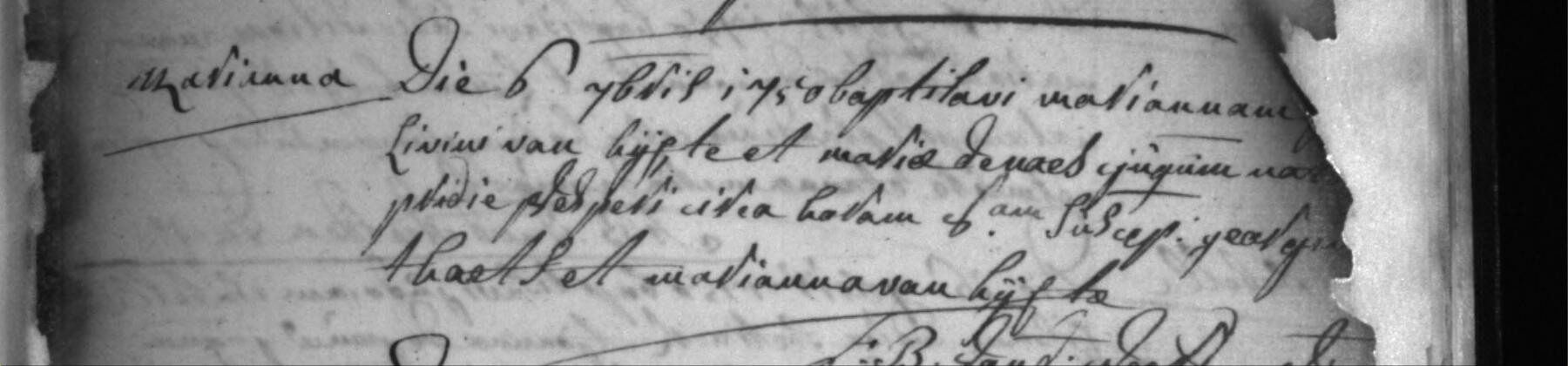
Transcription and translation
Marianna. Die 6 7bris 1750 baptisavi mariannam [filiam] Livini van hijfte et mariae denaes conjugum natam pridie circa horam 5am. Suscep[tores] [Georgius Thaets, the name damaged by a tear] et marianna van hijfte.
Marianna. On 6 September 1750 I baptised Marianna, daughter of Livinus van Hijfte and Maria Denaes, a married couple, born the day before at about five in the morning. Godparents Georgius Thaets, whose name is lost at the torn edge of the page, and Marianna van Hijfte.
The two are sisters. Both are daughters of the same couple, Livinus van Hijfte and Maria Anna Denaes, also written Den Haese, and it is this family that the Saeij records keep pointing back to. Their house can be put on the map, and their sorrow dated. On 25 November 1758 Lieven van Hyfte, son of Guilliaeme, died at Evergem Meirbeke, and on 7 February 1759 the court divided his estate. The clerk listed his widow, Marie den Haese, daughter of Pieter den Haese and Livijne Janssens, and the five children she was left with: Joanna Marie, ten, Marie Anna, eight, Isabelle, six, Frans, five, and Livijne, one. Her brother-in-law Joannes van Hyfte and her own brother Jacobus den Haese were appointed guardians on the two sides. The girl Bernardus would marry ten years later was one of the two eldest, a child of eight or ten standing in that room.5 Isabella van Hijfte, who stood as witness at the wedding in 1769 and as godmother to Petrus Franciscus in 1771, was baptised at Evergem in 1753, the next sister but one. In 1782 and again in 1788 the godmother of one of the babies was a Maria Denaese, or Den Haese, "from Evergem": the grandmother, who lived until 1810.6 So the house Bernardus married into is not in doubt. Which of the two girls he married is: the register in 1769 calls the bride Joanna Maria, which is the elder sister's name, while every later tree makes her the younger. One of the two may have died as a child - the Evergem burials would say - and until they are read, the safest thing to write is that Bernardus married a daughter of Livinus van Hijfte and Maria Anna Denaes, born at Evergem in 1749 or 1750.
Ten children
For twenty years the babies came, all of them carried to Sint-Joris to be baptised:7
- Joannes, born on 25 October 1769, at ten at night. His godmother was his grandmother Georgia.
- Petrus Franciscus, on 15 March 1771, with Isabella Van Hyfte as godmother.
- Joannes Franciscus, on 12 October 1772, godfather a Franciscus Saey.
- Petrus Dominicus, on 23 April 1774.
- Bernardina Coleta, at half past eight in the morning of 15 February 1776.
- Judocus Bernardus, at half past five in the afternoon of 17 August 1777, with Petrus Franciscus Van Hyfte as godfather. He is the next link in the chain.
- Isabella Theresia, on 13 March 1780.
- Coleta, at one in the morning of 22 April 1782. Her godfather was Petrus De Muynck, who had married Bernardus's cousin Joanna Saey the year before.
- Severinus, on 29 August 1785.
- Victoria, on 22 January 1788, at ten at night. The midwife, Carola Hennebaut, baptised her during the birth.
From 1774 on, the entries usually add that the father was "from Sleidinge" and the mother "from Evergem".7 Van Hyftes stood godparent to three of the children, and people from Evergem to two more. Maria Anna's family was close at hand.
The parish kept its own count of losses. A baby boy of Bernardus and Maria Anna died unnamed on 2 January 1791. On 27 December 1793 Petrus Dominicus died at nineteen, unmarried.8 He is the last of Bernardus's household to appear in the Sleidinge registers. It had been the family's parish for almost a hundred and forty years.
The world turned upside down
The children grew up in years when the old order of the Austrian Netherlands began to shake. In the 1780s the emperor Joseph II, Maria Theresa's son, pressed through reforms that many of his subjects saw as an attack on the Catholic Church. In 1789 they rose against him. An army of exiles crossed the border and defeated the Austrians at Turnhout on 27 October 1789, and in January 1790 the provinces declared themselves independent as the United Belgian States. No foreign power recognised them. By December 1790 the Austrians were back.9
Then came revolutionary France. On 6 November 1792 a French army defeated the Austrians at Jemappes, near Mons, and eight days later Brussels fell. The French were driven out again after their defeat at Neerwinden on 18 March 1793. The next summer they returned, and after the battle of Fleurus on 26 June 1794 the Austrians gave up the Low Countries for good.10 On 1 October 1795 the Austrian Netherlands were annexed to the French Republic. The old county of Flanders disappeared from the map. Sleidinge, Kaprijke and their neighbours became part of the department of the Escaut, the Scheldt, with Ghent as its capital. The new department also took in the strip of Dutch Flanders across the old border, which the new Batavian Republic had ceded to France that same year.11
Kaprijke
Some time in these years, between the burial of Petrus Dominicus at the end of 1793 and the spring of 1800, the family left Sleidinge. They went to Kaprijke, about ten kilometres to the north, towards the Dutch border.12
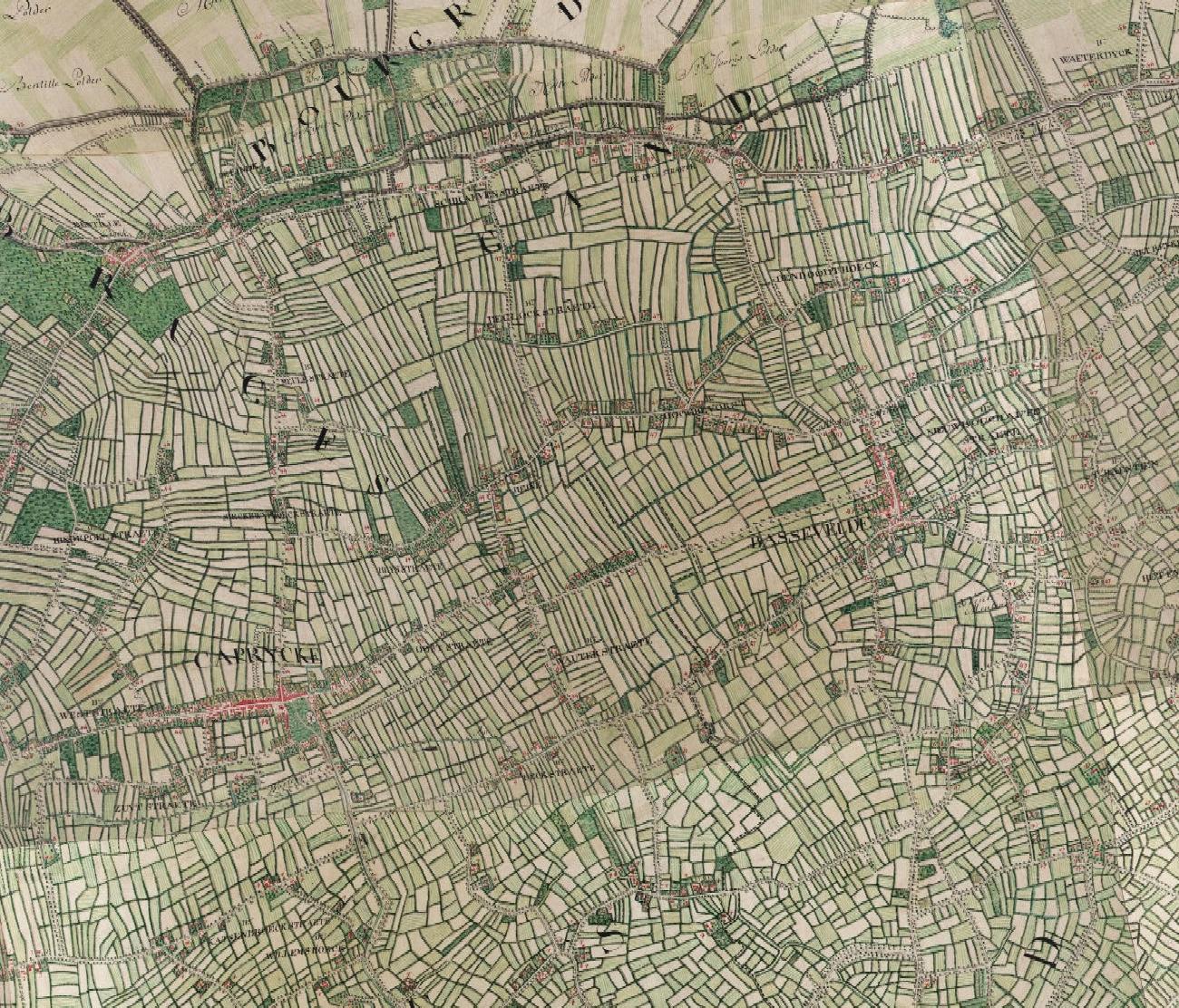
Kaprijke was an old place. It is first mentioned in 1233, and in 1240 the Countess of Flanders, Johanna of Constantinople, gave it a charter of freedom. It had two parts: the rural Kaprijke Buiten, and the busy centre, Kaprijke Binnen, around its green, the Dries. In the Middle Ages its people made cloth. After 1421 they turned to flax and linen, and from 1626 until the end of the old regime Kaprijke was a lordship.13 On the Ferraris map of 1777 its centre is picked out in red among the fields. Bassevelde lies to the north-east, and along the top of the sheet runs the dyke, with the reclaimed polders beyond it.
On 17 June 1796 civil registration was introduced in the Belgian departments. The registration of births, marriages and deaths passed from the parish priest to a municipal official, and the family's records change character from that moment. They are no longer short Latin entries but civil acts, in Dutch or in French, naming parents, ages, trades and witnesses. They are dated by the calendar of the Republic, with its years counted from 1792 and its months with new names, until Napoleon abolished it on 1 January 1806.14 Under the French, Kaprijke was also the seat of a canton, and a law of 1798 required marriages to be celebrated at the seat of the canton, before an official of the Republic. So for a time couples from all the villages around came to Kaprijke to marry.
The calendar was not the only thing the Republic changed. Its campaign against the Church closed churches and persecuted priests, and in 1798 a new law made young men liable for conscription. In October of that year the countryside of Flanders rose in the Peasants' War. The rising began at Overmere, east of Ghent, on 12 October 1798 and was crushed near Hasselt on 5 December. Many thousands died in the fighting, and the French executed some 190 people afterwards.15 No record found so far connects anyone in the family with it.
A wedding in the Temple of the Law
The first family record of the new regime is a wedding. On 30 Floréal of the year VIII of the Republic, which was 20 May 1800, Bernardus's daughter Bernardina Coleta, twenty-four years old, married Joannes Franciscus Claeys of Oost-Eeklo at Kaprijke. The ceremony was held in what the act calls the Tempel van de Wet, the Temple of the Law, in the chief town of the canton. The officiant was the president of the canton's municipal administration, acting under the law of 13 Fructidor of the year VI.16
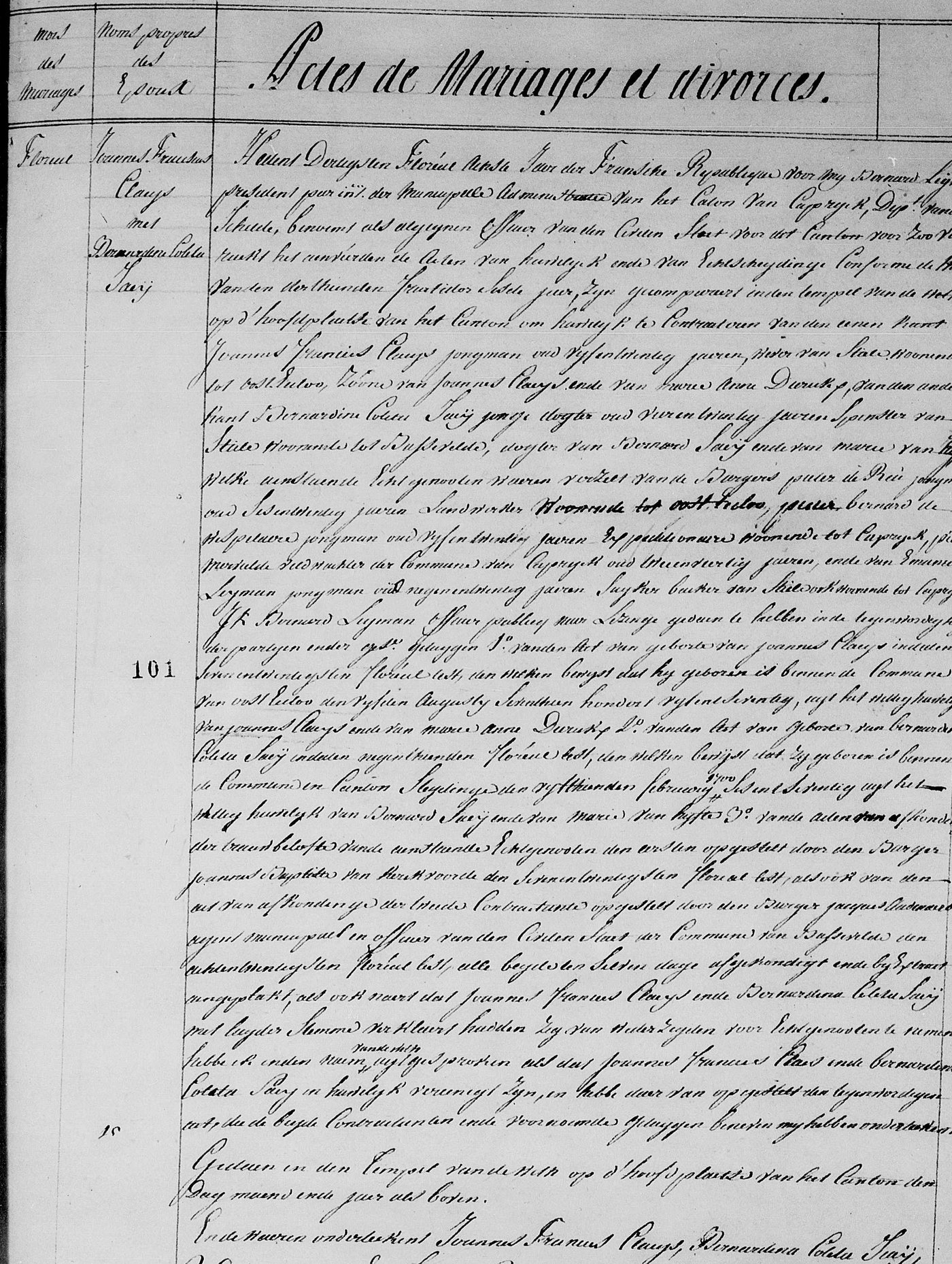
Transcription and translation
Heden dertigsten [?] Floréal achtste jaer der Fransche Republique ... zyn gecompareert inden tempel van de Wet op d'hoofdplaetse van het Canton om huwelyk te contracteeren van den eenen kant Joannes Franciscus Claeys jongman ... woonende tot Oost-Eecloo, zoon van Joannes Claeys ende van vrouwe Anna Durick [?], van den anderen kant Bernardina Coleta Saeij jonge dogter oud vier en twintig jaeren Spinster van Staet woonende tot Bassevelde, dogter van Bernard Saeij ende van marie van Hyfte ... [den act van geboorte] bewyst dat zy geboren is binnen de Commune en Canton Sleydinge den vyfthienden february 17 ses en seventig ... Gedaen in den Tempel van de Wet op d'hoofdplaetse van het Canton.
Today, 30 [?] Floréal of the eighth year of the French Republic [20 May 1800] ... there appeared in the Temple of the Law at the seat of the canton, to contract marriage, on one side Joannes Franciscus Claeys, bachelor, living at Oost-Eeklo, son of Joannes Claeys and Anna Durick [?]; on the other Bernardina Coleta Saeij, unmarried, aged 24, a spinner by trade, living at Bassevelde, daughter of Bernard Saeij and Marie van Hyfte ... [her birth act] proves that she was born in the commune and canton of Sleidinge on 15 February 1776 ... Done in the Temple of the Law at the seat of the canton.
The act describes the bride as spinster van staet, a spinner by trade, living at Bassevelde, and the daughter of "Bernard Saeij ende van Marie van Hyfte". Her birth at Sleidinge on 15 February 1776 was proved from an extract of her birth record. Her witnesses were a labourer from Oost-Eeklo, a clerk, the field guard of Kaprijke, and a nineteen-year-old sugar baker.16 Two years later, in July 1802, her brother Judocus Bernardus married at Bassevelde. His story is chapter 7.
The gin seller of Kaprijke
In the early hours of 18 April 1809, at about one o'clock in the night, Bernardus died at Kaprijke. That same day two men came to the mayor to declare the death: a notary, aged forty-three, and a man of private means, aged thirty-four. The mayor wrote the act in French, the language of the Empire:
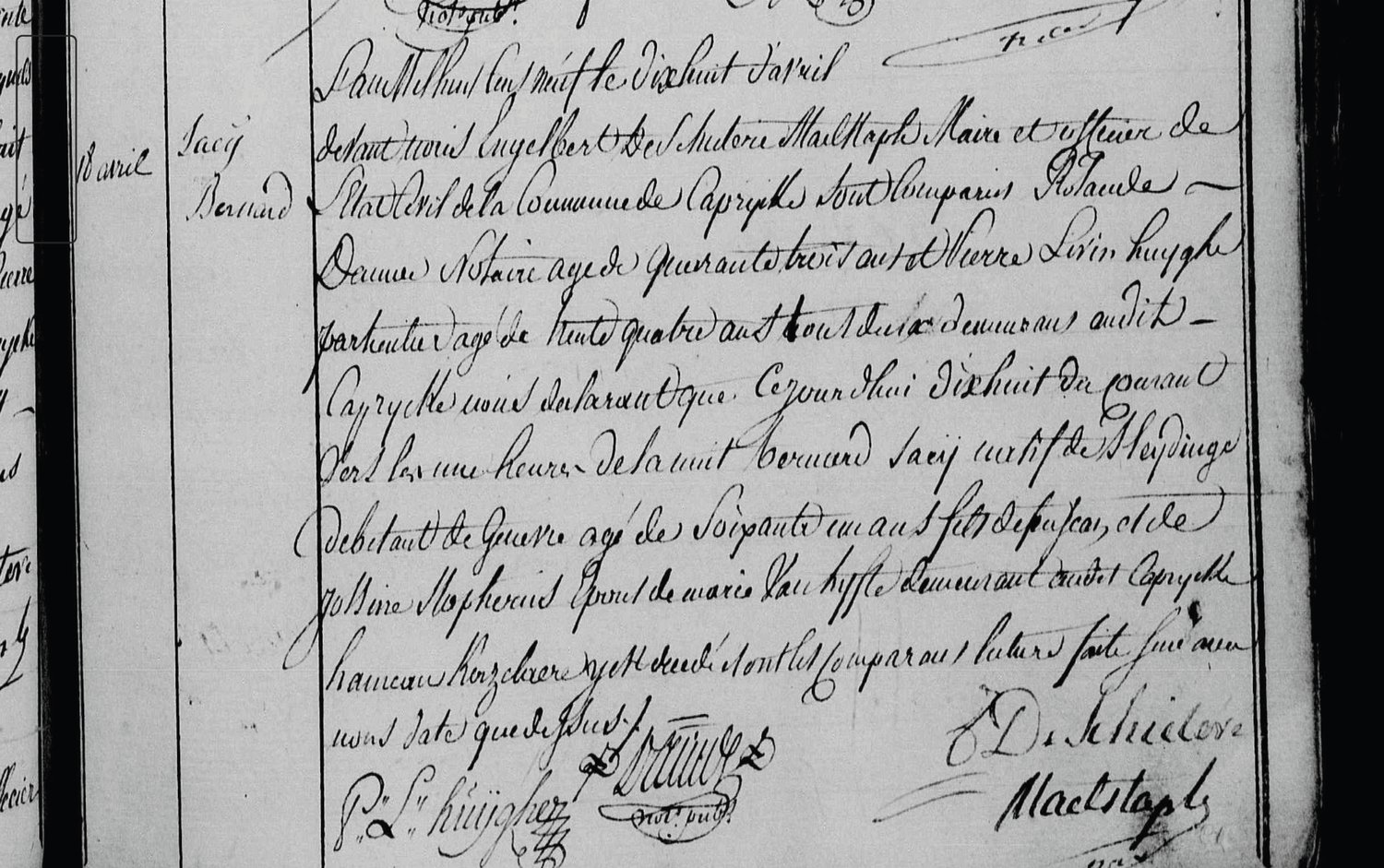
Transcription and translation
L'an mil huit cent neuf le dix huit d'avril devant nous Engelbert De Schuitere [?] Maire et officier de l'état civil de la Commune de Capryke sont comparus [Rolande?] Dauwe Notaire agé de quarante trois ans et Pierre Livin Huyghe particulier agé de trente quatre ans tous deux demeurans audit Capryke nous ont declaré que ce jourd'hui dix huit du courant vers les une heure de la nuit Bernard Saeij natif de Sleydinge debitant de Genievre agé de soixante un ans fils de feu Jean [?], et de Jossine Stopherus, Epoux de marie Van hyffe demeurant audit Capryke hameau Kerzelaere [?] y est decedé dont les comparans lecture faite ont signé avec nous date que dessus.
In the year 1809, on 18 April, before us, Engelbert De Schuitere [?], mayor and civil registrar of the commune of Kaprijke, appeared [Rolande?] Dauwe, notary, aged 43, and Pierre Livin Huyghe, of private means, aged 34, both living in Kaprijke. They declared that today, the 18th of this month, at about one o'clock in the night, Bernard Saeij, native of Sleidinge, seller of gin, aged sixty-one, son of the late Jean [?] and of Jossine Stopherus, husband of Marie Van hyffe, living in Kaprijke, hamlet Kerzelaere [?], died there. The act was read to the declarants, who signed it with us.
Bernard Saeij natif de Sleydinge débitant de Genièvre agé de soixante un ans fils de feu Jean et de Jossine Stopherus, Epoux de Marie Van hyffe demeurant audit Capryke: "Bernard Saeij, native of Sleidinge, seller of gin, aged sixty-one, son of the late Jean and of Jossine Stopherus, husband of Marie Van hyffe, living in Kaprijke." The hamlet where he lived is written in a word that is hard to read, perhaps Kerzelaere.17
So in his last years Bernardus sold genever, the juniper spirit of the Low Countries. Whether he kept a tavern or sold it by the jug the act does not say. The ages fit: born in January 1748, he was sixty-one. "Jean" is the French form of Joannes. "Jossine Stopherus" is the clerk's version of his mother's name, Georgia Stofferis, heard and written down almost forty years after her death.17 Bernardus died a subject of the Emperor Napoleon, in a department of France.
Maria Anna
Maria Anna outlived him by at least twelve years. On 30 November 1821 she was at Bassevelde for the second marriage of her son Judocus Bernardus. She was then living at Kaprijke and working as a werkvrouw, a labouring woman. She was present and gave her consent. At the end of the act the clerk noted that she could neither write nor sign her name.18 When and where she died has not yet been found.
Of the ten children baptised at Sleidinge, only two can so far be followed in the records of Kaprijke and Bassevelde. One is Bernardina Coleta, the spinner who married in the Temple of the Law. The other is Judocus Bernardus, who became a farmer at Bassevelde.
-
Baptism of Bernardus, 28 January 1748 [S35]; burial of Joannes Saey, 23 January 1767 [S28] (grade A); burial of Georgia Stopheris, 15 December 1770 [S6] (grade B). ↩
-
Evergem marriages 1751–1782, page 246, read from the image on 22 September 2026 [S88] (grade A): "Die 26 x[b]ris contraxerunt sponsalia Bernardus Say et Joanna Maria van Hijfte, testibus Georgio van Hecke et Isabella van Hijfte; factisque tribus bannis, die 7 janu[arii] contraxerunt matrim[onium] coram me et testibus iisdem." The heading on the page is "Anno 1768", which governs the betrothal; the wedding on 7 January falls in 1769. Until this reading the date came only from the family trees (grade D) [S36]; the FV-Meetjesland indexes of Evergem begin after 1776, which is why it had not been checked. ↩
-
Sleidinge baptism index, 1769–1788 [S5] (grade B); civil acts of 1800, 1802, 1809 and 1821 [S46–S49] (grade A). ↩
-
Evergem baptisms 1746–1762, page 57, read from the image on 22 September 2026 [S89] (grade A for the entry; grade B for the identification with Bernardus's wife): "Die 6 7bris 1750 baptisavi mariannam [filiam] Livini van hijfte et mariae denaes conjugum natam pridie circa horam 5am." The page reference comes from the FamilySearch reason statement for person GDWV-YM4 [S50]. Family trees give her father Livinus van Hijfte the dates 28 October 1719 – 25 November 1758 at Evergem; those have not been checked against the registers (grade D). The question between the two candidates is still open. ↩
-
L. Neyt, Staten van goed Graafschap Evergem, deel III (1740-1759), no. 460, dated 7 February 1759 [S90] (grade B, a published abstract): "st. Lieven van Hyfte fs Guilliaeme + Evergem Meirbeke 25.11.1758 ... He. Marie den Haese fa Pieter verwekt bij Livijne Janssens fa Jan ... deelvoogden pat. en mat. over Joanna Marie Van Hyfte 10j., Marie Anna 8j., Isabelle 6j., Frans 5j. en Livijne Van Hyfte 1j." The ages match the baptisms of 1749, 1750, 1753, 1754 and about 1757. The date of death, 25 November 1758, is the one the family trees carry without a source; this is the source. Reading notes:
evidence/svg_1758_livinus_vanhijfte.md. ↩ -
Baptism of Joanna Maria van Hifte, Evergem, 24 April 1749, born about six in the evening, godparents Joannes van Hifte and Marianna den Naes; and of Isabella van Hijfte, 1753; both from the abstracts quoted in the FamilySearch reason statements [S50] (grade C, not read from the images). Baptisms of Coleta, 22 April 1782, "godmother Denaese Maria Anna (uit Evergem)", and of Victoria, 23 January 1788, "godmother Den Haese Maria (uit Evergem)" [S5] (grade B). That she was the grandmother is an inference (grade C). ↩
-
Sleidinge baptism index, 1769–1788, with hours and godparents [S5] (grade B). Petrus De Muynck's marriage to Joanna Saij, daughter of Petrus, 28 April 1781 [S7] (grade B). ↩↩
-
Sleidinge burial index, 2 January 1791 (a boy, father Bernardus, mother Joanna Maria Van Hyfte) and 27 December 1793 (Petrus Dominicus, "unmarried, 19 years") [S6] (grade B). The first Say entry in the Sleidinge registers that we have linked to this family is the marriage of 1655 [S1]. ↩
-
Battle of Jemappes, Wikipedia [S40]; Austrian Netherlands, Wikipedia [S23]. ↩
-
Escaut (department), Wikipedia, English and French [S41]; Austrian Netherlands, Wikipedia [S23]. ↩
-
The move is dated by the last Sleidinge burial (December 1793) [S6] and the Kaprijke marriage of May 1800, which gives the bride's residence as Bassevelde [S47] (grade C for the dating). The distance is measured on a modern map. ↩
-
K. Lanclus, Dries van Kaprijke, Inventaris Onroerend Erfgoed (2015) [S45]. ↩
-
W. Dezutter on the introduction of civil registration [S43]; French Republican calendar, Wikipedia [S42]. ↩
-
Marriage of Joannes Franciscus Claeys and Bernardina Coleta Saeij, canton of Kaprijke, act 101, 30 Floréal year VIII [S47]. Read from the image (grade A). The act cites the law of 13 Fructidor year VI (30 August 1798), under which marriages were celebrated at the seat of the canton; a Bassevelde couple of 1798 was also married in the Kaprijke canton register (act 80) [S47]. The day of the month is read as dertigsten, the thirtieth; the certificates recited in the act are dated 27 and 28 Floréal, which supports it. ↩↩
-
Death of Bernard Saeij, Kaprijke, 18 April 1809 [S46]. Read from the image (grade A). The date, name, birthplace, trade, age and wife are clear. The parents' names and the hamlet are harder to read (medium confidence). ↩↩
-
Second marriage of Judocus Bernardus Saey, Bassevelde, 30 November 1821 [S49]. Read from the image (grade A). ↩