Chapter 5. The other Saey families of the region
Chapter 4 leaves Livinus Saij standing alone: a man of about twenty-eight at his wedding in 1655, with a father called Jan and no proven kin. He was not, however, the only Say in the country north and east of Ghent. Between about 1600 and 1650 there were at least eight Say households within a twenty-kilometre arc of the city, and their papers are the ground on which any answer about Livinus will have to be built. This chapter sets them out, family by family, so that the names can be told apart.23
A word of warning about names. The clerks wrote Say, Saey, Saeij, Saij, Sey, Saeys and Zaey, and the spelling followed the clerk and the decade, never the family. What identified a man was not his spelling but his father: in the court papers he is "Lieven Saeij fs Jan", Lieven, son of Jan. That habit is the only reason these families can be separated at all.
Our own household at Sleidinge
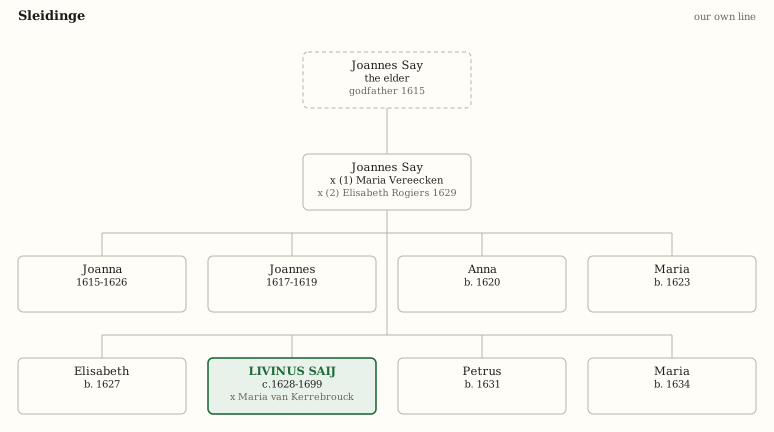
Joannes Say and Maria Vereecken were the only Say family living at Sleidinge when Livinus was born, and the chapter "Before the line" sets out the case for making him their son. It is worth noticing how ordinary their losses were: of the eight children in the tree, four were buried as infants or young children.1
Kluizen, Ertvelde and Winkel: the largest family
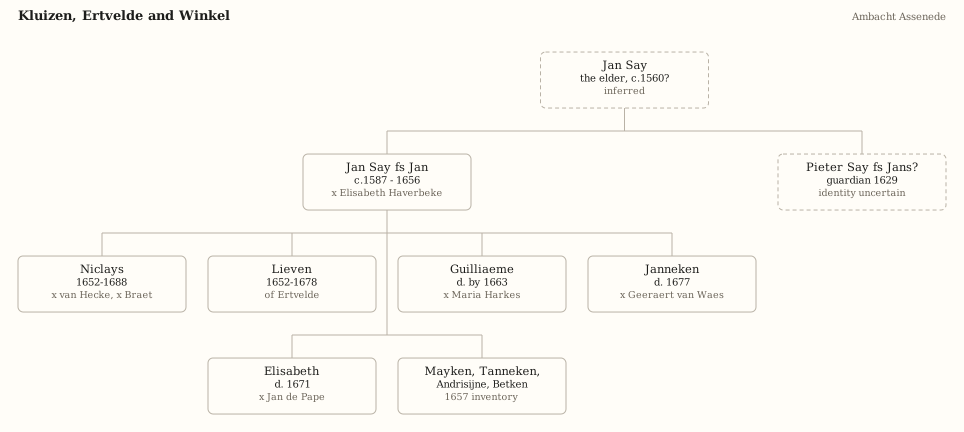
Five kilometres north-east of Sleidinge, at Kluizen, lived the largest and best-documented of these families. Its head was Jan Say, son of Jan, who gave evidence before a court at Zelzate in April 1629 and said he was forty-two, a landsman and tax collector at Kluizen. He died in the spring of 1656, and the inventory of his estate, drawn up in February 1657, lists seven children of age.2
Two of his sons run through the district's papers for thirty years. Niclays stood guardian for orphan after orphan between 1652 and 1688; Lieven, called "Lieven Saey fs Jans", did the same from 1652 until 1676, by then living at Ertvelde, where he died in 1678.3 Their sisters married into the farms of Winkel and Ertvelde. The family stood godparent for one another constantly: in the Kluizen baptism register, read here for the years 1642 to 1660, a Say is godfather or godmother at a dozen baptisms, and the family's own children appear exactly where the inventories say they should.4
This is also why Livinus is unlikely to have been a close relative of theirs. In nineteen years of that register, not one Sleidinge Say appears at Kluizen, as parent or as godparent, though Sleidinge lies an hour's walk away.
Evergem and the Sint-Albertpolder
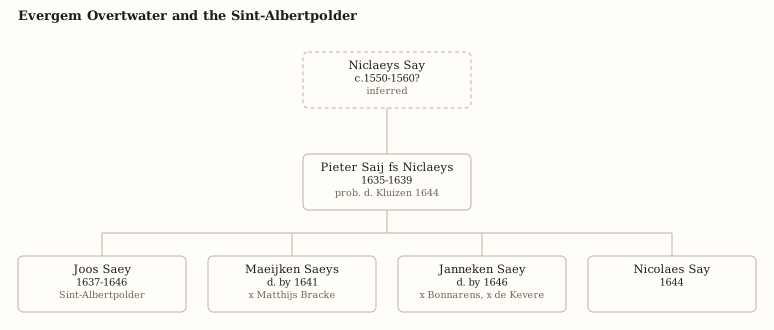
A second western family held land at Evergem Overtwater. Pieter Saij, son of Niclaeys, acted as guardian there in 1635 and again in 1639, each time beside a Criel.5 His son Joos farmed in the Sint-Albertpolder, north of Assenede, where in 1638 a witness described working for him as a horse-boy; Joos stood godfather at Zelzate in 1628, and acted for his sister Maeijken's children at Evergem in 1641.6
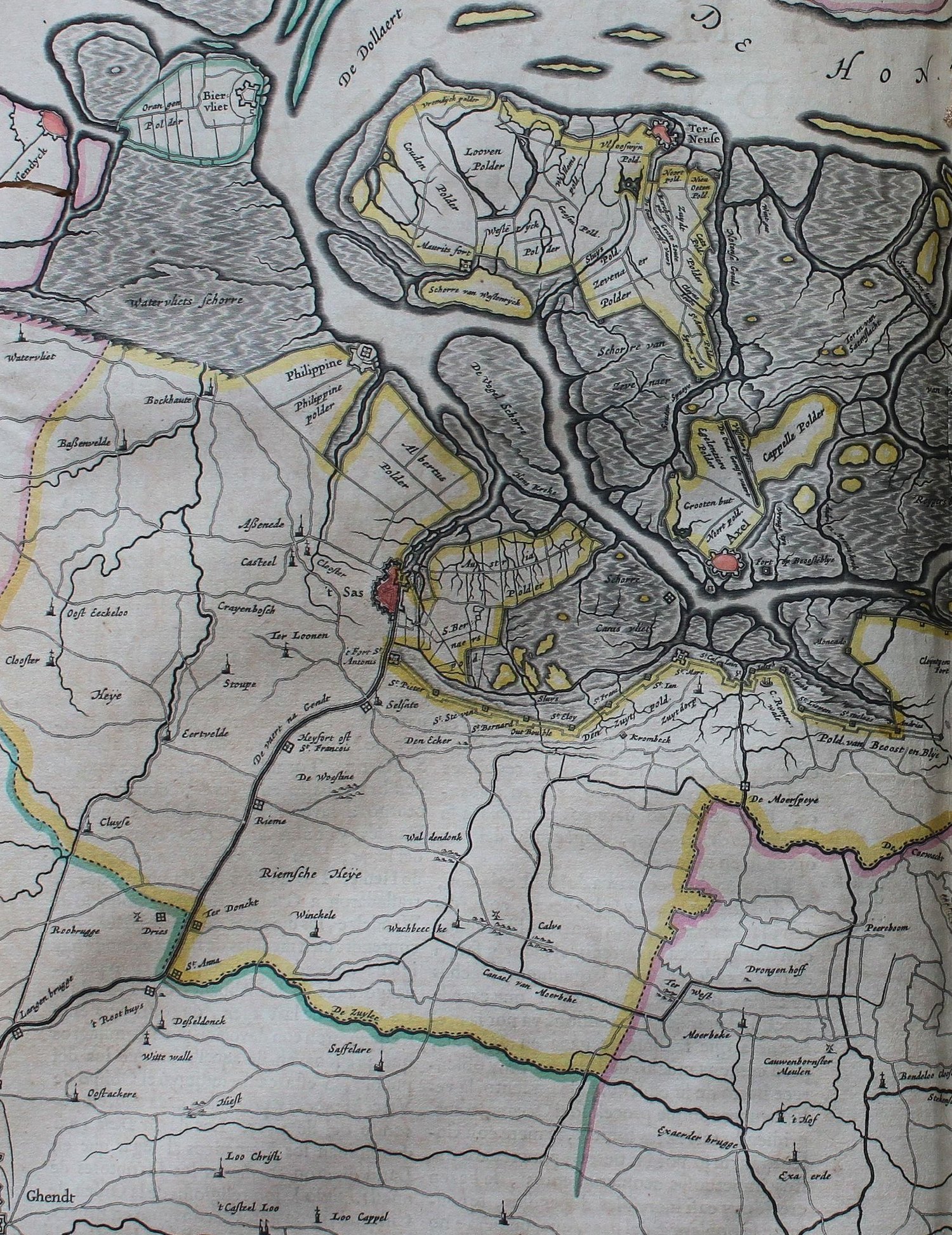
It is worth stopping at that polder, because it tells you what kind of country this was. North of Assenede the land was not old. It had been sea. A run of storm surges in the fourteenth and fifteenth centuries had opened a great inlet here, the Braakman, which older maps call the Dollaert: the surge of 1375 tore the first breach, in 1440 it widened and swallowed the parishes of Steenland, Eertinge, Peerboom, Moerkerke and Sint-Janscapelle, and by about 1570 it reached its greatest size. At least fifteen villages drowned in it between 1200 and 1601.7 Then the war made it worse on purpose: to stop the Spanish advance, the States army cut the dykes in 1583, and again in 1584 and 1585, and Prince Maurice cut more after he took Axel in July 1586. Polders went back to salt marsh, and new sea channels drove kilometres inland.8
The winning back began in Joos Saey's grandfather's lifetime. On 9 November 1610 Archduke Albert granted the charter to dike the marshes and mud flats of Sint-Jan under Assenede; the work was finished in 1612, though only about two thirds of what was intended, some 980 hectares, and the deed dividing the new ground into twenty parcels was signed on 13 July 1612. The polder took the archduke's name. Before that it had been the Sint-Jansschorre, after the drowned parish.9 So when Joos Saey was farming there in the 1630s, he was working a field younger than he was, on ground that his father had seen under salt water.
There is a thread here worth pulling, and it leads somewhere. In 1639 Pieter was named guardian for the mother's side of the orphans of Stoffel Criel and Janneken van Hijste, and in 1635 he had done the same for the children of Frans Criel and Margriete van IJste. The two mothers were sisters, daughters of a Christoffel van Hijfte. A guardian on the mother's side was her brother or her brother-in-law, and Pieter was no Van Hijfte: he must have been married to a third sister.10
Now turn to Kluizen. The Pieter Saey whose estate was inventoried there in February 1644 had married first a Joosijntken van Hyfte, and then a Nijntken Criel, daughter of Jan; and one of the guardians appointed for his children was Christoffel Criel, the very widower of the 1639 case. His little daughter's baptism at Kluizen in October 1642 names her mother as a Criel, with a Catharina Criel as godmother.11 Two men of one name, in adjoining villages, in the same fifteen years, each marrying into the Van Hijfte family and each tied to the same Criel brothers: they are almost certainly one man, who moved the few kilometres from Evergem Overtwater to Kluizen.
That matters for a reason beyond tidiness. The guardians of his children in 1644 were Christoffel Criel, for the mother's side, and "Jan Saey fs Jans" for the father's. Jan Saey, son of Jan, is the head of the Kluizen family, the man who told the court in 1629 that he was forty-two. A father's-side guardian is a father's-side kinsman. It is the first thread that ties the Evergem family of Niclaeys to the Kluizen family of Jan — cousins, or an uncle and his nephew.12
Zelzate, Wachtebeke and the confusion of Lievens
At Zelzate a Lieven Say married Joorijntken Grijp; his estate was inventoried in 1677, and the guardians appointed for his children were an Adriaen Say son of Pieter and an Adriaen Say son of Lieven, two cousin lines of the next generation.13 A Jan Say died there in 1672, leaving a son Jaecques who was dead himself by 1680.
By now the reader may be losing count of the Lievens, and so, for two centuries, did everyone else. Between 1620 and 1690 there were at least six grown men of that name: ours at Sleidinge; the Kluizen brother who moved to Ertvelde; a Lieven at Zelzate; a Lieven at Desteldonk; a Lieven at Destelbergen; and the man who married Judoca Teerlinck at Sleidinge in 1645 and was dead within three years. It was precisely this crowd of namesakes that let the published family trees attach our line to the wrong one.
Desteldonk, and a bridge to the east
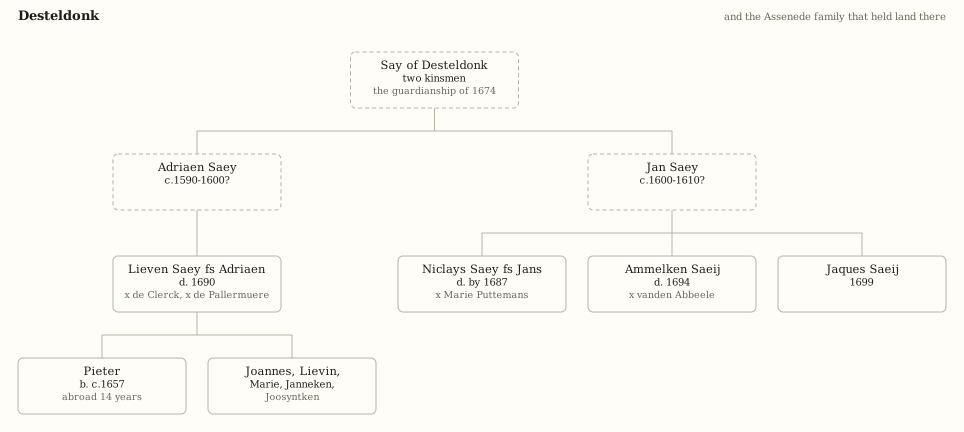
East of the Ghent canal, at Desteldonk, two Say lines lived side by side: the children of an Adriaen and the children of a Jan. That they were kin is not a guess: when the children of Niclays, son of Jan, were provided with guardians in 1674, the guardian for the father's side was Lieven, son of Adriaen.14
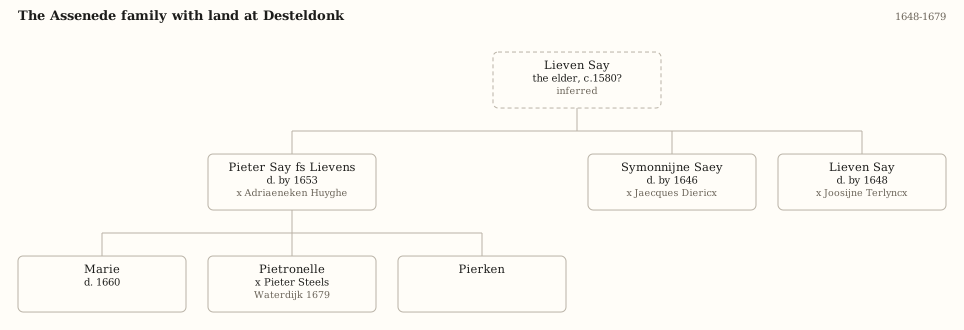
A second family, this one from the Assenede district in the west, also held land at Desteldonk, and held it undivided, which is to say as an inheritance not yet split up. The papers name three of them: Pieter, son of Lieven; his sister Symonnijne, wife of Jaecques Diericx; and a Lieven who died by 1648 leaving two small children. Their shared plot at Desteldonk is still described as undivided in 1679, in the estate of Pieter's daughter Pietronelle.15
That undivided plot is the only documented thread between the western and the eastern families. Whoever owned it before 1648 is the nearest thing to a common ancestor that the records offer, and his name is not yet known.
Lochristi and Oostakker, and one death at Maldegem
A sixth group lived at Lochristi and Oostakker, east of the canal and next door to Desteldonk, and it is the longest-lived of them all: Says are still being buried at Lochristi in the eighteenth century, still spelling the name the old way. The same first names come round again and again - Adriaen, Niclays, Jan, Pieter - and the same in-law families, Van Acker and Van Doorselaere, that appear at Desteldonk.16
Three of their burials can be read from the registers, and they are worth setting down because they put flesh on what is otherwise a list of names. The first is a child. Joanna Say, daughter of Joannes, was buried on 4 May, having died the day before at four in the afternoon, aetatis 11 annorum, aged eleven. A Joanna, daughter of a Joannes, was baptised in this parish on 5 April 1621, the eldest child of Joannes Saey and Livina Eeckmans; she had turned eleven a month before she died, which dates the burial to 1632. The page has no year at its head, so that year is worked out from her age rather than read.17
Nearly a century later the same family is still there. Balduinus Say, husband of Joanna Glorieux, died on 14 June 1718 and was buried two days later, aged seventy-two, so born about 1646. His name is the interesting part: Boudewijn is the Destelbergen family's name, and Lochristi and Destelbergen adjoin. It is where a grandson of the Destelbergen Balduinus would stand - but nothing on paper connects them yet.18 On another page, undated at the head, Catharina Say, wife of Laurens der Weduwen, died at five in the morning and was buried on 30 March, aged forty-five.19
One record takes the name further west than any other. At Maldegem, twenty kilometres north-west of Sleidinge and outside the cluster altogether, Anna Seij, wife of Bartholomeus, was buried at midday on 29 March 1710, having died on the 26th, aetatis circiter 52 annos. A generation before her, the same parish had buried Catharina Seij, wife of Pieter Vermeersch, the sexton, in 1700. Whether the two were mother and daughter the records do not say.20
None of these people is an ancestor. They are the edges of the map.
Destelbergen: the family that was given to us by mistake
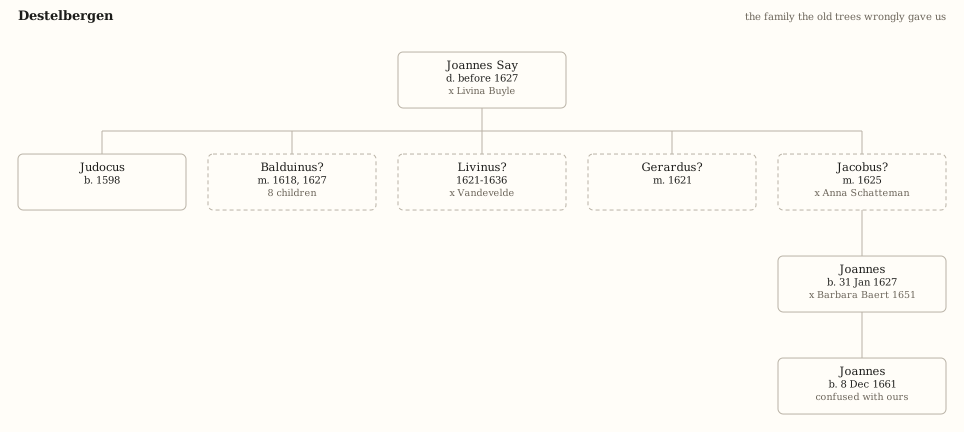
Finally, fourteen kilometres south-east of Sleidinge, at Destelbergen, lived the family that the published trees wrongly made our own. Its earliest couple, Joannes Say and Livina Buyle, had children baptised from 1598; a second household, under a Petrus, ran alongside it.21 The men who married at Destelbergen between 1618 and 1625 were probably their sons, but that is tree data, not record: their baptisms fall before the register begins.
One of them, Jacobus, married Anna Schatteman in 1625, and their son Joannes married Barbara Baert in 1651. It is a boy of theirs, baptised on 8 December 1661, who was merged with our Joannes of Sleidinge, born in June 1660. Chapter 4 tells how the Sleidinge records undo that link.22
Ghent itself, and a warning about the name Seys
The city of Ghent, which all these villages looked to as their market, had Says of its own. From 1605 the marriage registers of the city record a Petrus Sey, an Adrianus Sey and a Niclaeijs Sey, and later a Paulus Saij, a Mayken Saey and an Elisabeth Saey; a Joos Say was buried in the Ticstrate in 1646.24 One of these entries repays the reading. On 5 August 1653 a Livinus Saij, noted in the margin as "van oostakker", married Joanna Boosiers at Ghent, with a Petrus Saij standing witness. She is the Joanna Beaucier whose children were baptised at Oostakker from the next year; the city register has kept the date of a marriage the village register never recorded.25
This is also the place for a warning. Searching the archives for our name turns up, again and again, the family Seys, and there are hundreds of them: in the orphan registers of Kortrijk as early as 1424, and afterwards through Izegem, Menen, Wevelgem, Ieper, Veurne and Bruges, with a second crowd in the city of Ghent. It is tempting, because the name looks so close and the records are so old. But our family is never written Seys in the registers of Sleidinge, Kluizen or Evergem, and not one of those West Flemish Seys can be attached to our district. They are a different family with a similar name, and the temptation is best resisted.26
What the other families tell us
Three things, in the end.
- The name was not rare. Eight households in one small region, all using the same handful of first names: Jan, Lieven, Pieter, Niclays, Adriaen, Joos. Any argument from a name alone is worthless here.
- They divide into west and east. The western families of Kluizen, Evergem, Zelzate and Sleidinge are one world, the eastern families of Destelbergen, Oostakker, Lochristi and Desteldonk another. Only the undivided Desteldonk land of 1648 joins them.
- The generation that would join them is out of reach. It was born between about 1540 and 1580, before every parish register in the district and before the estate-inventory series. Unless a deed in the Ghent archives names them, that join will not be made from paper. A Y-DNA test between living male Says of different branches would test it another way.
-
Sleidinge baptism and burial indexes, 1614–1634 [S5, S6] (grade B). See the chapter "Before the line" for the full evidence on this household. ↩
-
Witness statement of "Jan Saije fs Jan", Zelzate, 9 April 1629, 42 years, "landsman en uitlegger in Kluizen" [S86] (grade B); estate inventory of Jan Say, Kluizen, 27 February 1657 [S39] (grade B). ↩
-
Guardianships and inventories of the Ambacht Assenede, 1652–1688 [S39] (grade B). Working file:
sleidinge/KLUIZEN_SAEY.md. ↩ -
Kluizen baptisms 1642–1666, State Archives Ghent, read image by image for 1642–1660 [S83] (grade A). Four baptisms match the estate inventories exactly: Elisabeth 1647 and Josina 1650, daughters of Niclays; Catharina 1642, daughter of Pieter; and Nicolaus 1659, son of Guilliaeme. Working file:
kluizen_1642/KLUIZEN_LOG.md. ↩ -
Estate inventories of the Graafschap Evergem, nos. 140 (1635) and 163 (1639) [S77] (grade B). ↩
-
Witness statement, Sint-Albertpolder, 1638 [S86]; Zelzate baptisms, 25 April 1628, read from the register [S85] (grade A); Evergem inventory no. 191 (1641) [S77] (grade B). ↩
-
Wikipedia (English), Braakman [S91]; Braakman voorgoed afgesloten, Zalig-Zeeland [S92]; and for the parishes drowned in 1440, De Sint-Janskapel in de Sint-Albertpolder, Ons Meetjesland 1980/1 [S93]: "Anno 1440 verwijdde de Braakman, verdronk Steenland, Eertinge, Peerboom, Moerkerke, Sint-Janscapelle." ↩
-
Ons Meetjesland 1980/1 [S93]: "Aartshertog Albertus van Oostenrijk gaf op 9 november 1610 octrooi voor de bedijking der schorren"; and Rijksarchief in België, on the 1612 charter handed over by the municipality of Assenede in 2017 [S95]. Context note 7 sets out the water history in full. ↩
-
Estate inventories of the Graafschap Evergem, nos. 140 (21 March 1635) and 163 (26 January 1639) [S77] (grade B). That the two mothers were sisters, and that Pieter's wife was a third sister, follows from the rule that the maternal guardian came from the mother's family (grade C). No. 675 (1677), the estate of Christoffel Criel fs Denys, names his first wife as "Janneken van Hyfte fa Christoffels" and their children Denijs and Joosijntken: the orphans of 1639 [S77]. ↩
-
Estate inventory of Pieter Saey, Kluizen, 23 February 1644 [S39] (grade B); baptism of Catharina Say, Kluizen, 3 October 1642, "filia Petri et [Christina?] Criel", godmother Catharina Criel [S83] (grade A). ↩
-
The same 1644 inventory: "V: Jan SAEY fs Jans; Lowijs BOTERMAN fs Jaecques; Christoffel CRIEL" [S39]. That Jan Saey fs Jans stood for the father's side, and is therefore Pieter's kinsman, is our inference (grade C). Working file:
say_network/PIETER_EVERGEM_KLUIZEN.md. ↩ -
Estate inventory of Lieven Say and Joorijntken Grijp, 15 June 1677 [S39]; Evergem inventory no. 353 (1658) [S77] (both grade B). ↩
-
Keure van Desteldonk, estate inventories, no. 41 (16 November 1674) [S84] (grade B). ↩
-
Assenede inventories, 1648–1653 [S39]; Waterdijk, estate of Petronelle Saey, 21 March 1679 [S82] (grade B). ↩
-
The Lochristi and Oostakker reconstruction, from the parish indexes and registers: eight households 1621-1794 [S25]. Working file:
say_network/SAY_FAMILIES_TO_1650.md, group F. ↩ -
Lochristi burials, FamilySearch image group 004455704, image 117 [S99] (grade A for the entry): "4 Maij sepulta est Joanna Say filia Joannis, obijt pridie hora quarta pomeridiana, aetatis 11 annorum." The baptism of Joanna Saye, 5 April 1621, register p. 11 [S25]. The identification, and with it the year 1632, is grade C. ↩
-
Lochristi burials, image group 004455737, image 79, folio 1390 [S100] (grade A): "Die 16 Junij sepultus est Balduinus Say maritus Joannae Glorieux, obijt 14, aetat: 72 an." The Destelbergen parallel is a hypothesis only (grade D). The death was already known from the index [S25]; the image confirms it and adds his age. ↩
-
Lochristi burials, image group 004455721, image 126, folio 1157 [S101] (grade A): "30 martij sepulta Catharina Say uxor Laurentij der Weduwen, obijt pridie hora quinta matutina, aetatis 45 annorum." The opening has no year heading. The same page records "25. Maij sepulta Elizabetha Coots uxor Joannis Say Aerds". ↩
-
Maldegem burials, image group 004456141, image 205, folio 75, under "Martius 1710" [S102] (grade A): "[2]9 sepulta est sub meridiem anna Seij uxor Bartholomaei S[...] obijt 26, aetatis circiter 52 annos." The husband's surname could not be read with confidence. Catharina Seij, about 1628 - 6 July 1700, wife of Pieter Vermeersch, koster at Maldegem, from the FV-Meetjesland "Verwantschappen De Eik" index, records 42671 and 44268 [S21] (grade B). That the two women were mother and daughter is unproven (grade D). Readings:
say_network/LOCHRISTI_MALDEGEM_READINGS.md. ↩ -
Destelbergen index tables [S37] (grade B); 73 households were reconstructed from them, of which 25 at Destelbergen. Working file:
destelbergen/FAMILIES.md. ↩ -
Destelbergen baptism index, 8 December 1661 [S37] (grade B); see chapter 4. ↩
-
The trees in this chapter are drawn from
say_network/SAY_FAMILIES_TO_1650.md, which cites the record behind every person, and marks the links that are inferred rather than documented. A dotted box means a person or a link that no record proves. ↩ -
AGATHA, analyses of records, Ghent marriage and burial registers, 1605–1653 [S87] (grade B). Working file:
agatha_analyses/FINDINGS.md. ↩ -
Ghent marriage register, 5 August 1653: bride Joanna Boosiers, groom Livinus Saij "van oostakker", witnesses Petrus Saij and Joannes Carpentier [S87] (grade B). The Oostakker baptisms of Livinus Say and Joanna Beaucier(s) from 1654 are in the reconstruction of the east-Ghent families [S37] (grade B). ↩
-
Of 564 records found for thirteen spellings between 1400 and 1650, about 480 are Seys, Seijs or Seis, nearly all of them West Flemish [S87]. ↩