Part One. Sleidinge, 1627 to 1767
Chapter 1. Livinus Saij and Maria Van Kerrebrouck, 1627 to 1699
A January morning in 1699
On 20 January 1699, at about eleven o'clock in the morning, an old man died in the parish of Sleidinge. His home was on the Volpenswege, the long road that runs along its eastern edge. He had received the last sacraments. The parish priest of Sint-Joris wrote the burial into his register in the Latin of the Church: obiit omnibus sacramentis munitus Livinus Saey, aetatis suae anno septuagesimo secundo. Livinus Saey had died, fortified with all the sacraments, in the seventy-second year of his age. Beneath the entry the priest wrote the name of the road where he had lived.1
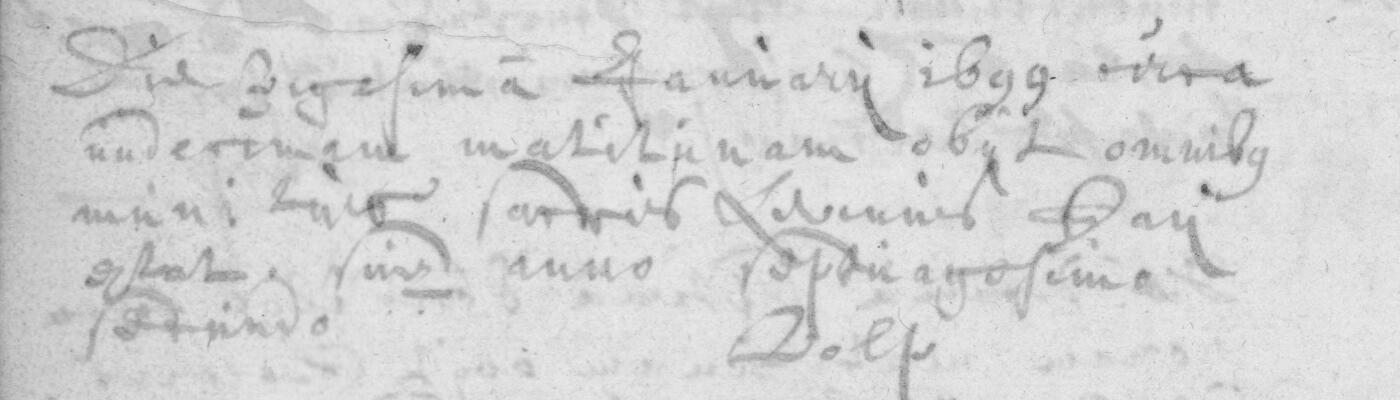
Transcription and translation
Die vigesima Januarii 1699 circa undecimam matutinam obiit omnibus [sacramentis] munitus Livinus Saey aetatis suae anno septuagesimo secundo. — Volp[enswege]
On 20 January 1699, at about eleven in the morning, Livinus Saey died, fortified with all the sacraments, in the seventy-second year of his age. (Residence:) Volpenswege.
Seventy-one years earlier, then, Livinus Saij had been born, some time between the end of January 1627 and January 1628. He is the first member of this family whose life can be followed in the records, and the first link in an unbroken chain that runs, father to son, for nine generations to the twentieth century. His father's name is known from two records, the inventories made after his wife's death and after his own: he was "Lieven Saeij fs Jan", Livinus, son of Jan.29 Who that Jan was is not proven; the most likely answer, Joannes Say and Maria Vereecken of Sleidinge, is set out in the chapter "Before the line". Where he was born, and who his mother was, is not known. No baptism of a Livinus Say has been found at Sleidinge in those years, although both of the parish's baptism books for the 1620s have been searched.2 He may have come from one of the villages around. He is first seen in Sleidinge on the day of his betrothal, in October 1655. The question of where he came from is taken up in chapter 4.
The world he was born into
In the 1620s the country that is now Belgium was the Spanish Netherlands: a cluster of provinces in the Low Countries, the county of Flanders among them, held from 1556 to 1714 by the Spanish branch of the Habsburg family.3 The northern provinces had broken away in a revolt against Spanish rule and made themselves into a republic, the Dutch Republic of the United Provinces. Spain had been fighting to win them back for decades, in the long struggle later called the Eighty Years' War.
From 1598 the southern provinces were governed by the Archdukes Albert and Isabella. Isabella was the daughter of King Philip II of Spain, and Albert, her husband, an Austrian Habsburg. Their rule brought a period of peace and stability that the country badly needed.3 By 1607 Spain was bankrupt and had suspended payment of its debts; the Dutch could not deliver a knockout blow either. Both sides were exhausted. On 9 April 1609, at Antwerp, Spain and the Archdukes on one side, and the States General of the Dutch Republic on the other, agreed to a Twelve Years' Truce. It was a pause, not a peace. Spain saw it as forced on it by lack of money, and when it expired on 9 April 1621 the war began again.4
The Archdukes used the quiet years to prepare. From 1613, with their permission, a new defensive line was dug across northern Flanders: the Brugse Vaart, the canal from Bruges to Ghent, which passed south of Sleidinge.5 When the fighting resumed after 1621, the country north of that canal, as far as the Sasse Vaart that ran north to Sas van Gent, was occupied by the Dutch. Evergem and Sleidinge lay inside it. It became contributieland, contribution land, which paid the enemy's army to be left alone. A string of small forts was built along both canals.5 The war had emptied much of the district once before: in 1592 the ruined churches of Ertvelde and Kluizen, Sleidinge's neighbours, had served as military strongholds, and at times the country around Evergem was all but uninhabited.5
So Livinus was born in occupied border country, a few years after the truce ended. He was about twenty when the war ended. On 30 January 1648, at Münster in Westphalia, King Philip IV of Spain and the Dutch Republic signed a peace in which Spain recognised the Republic's independence and kept the southern provinces.6 The frontier between the two states was drawn through the Vier Ambachten, the old districts just to the north.5 It is still the border between Belgium and the Netherlands. Two centuries later, Livinus's descendants would cross it.
Sleidinge
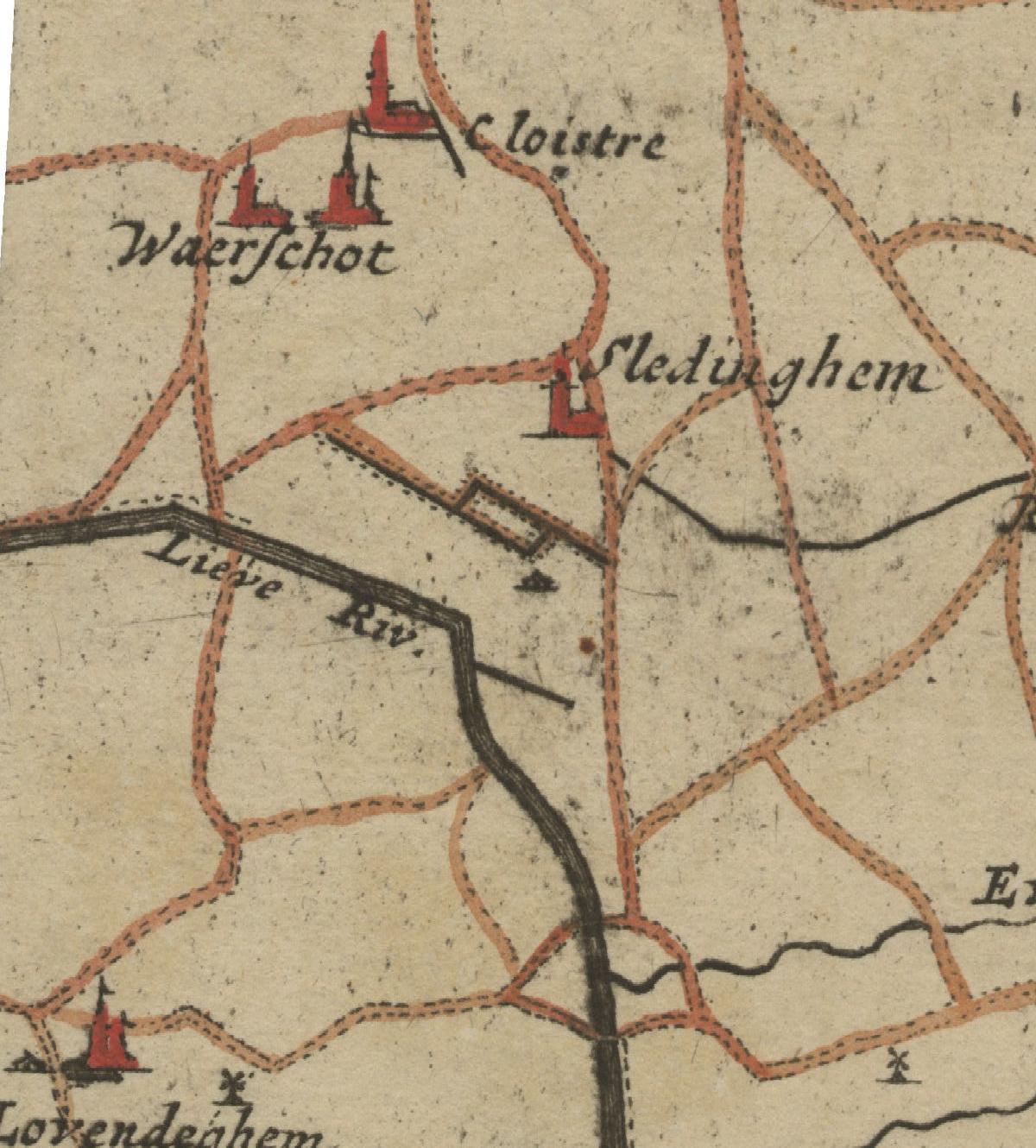
The parish in which Livinus married and raised his children was a low, wet country of heath, fields and meadows north of Ghent. The name, first written Scleidingha in 1220, is usually explained as "slippery place", and the land was notably low and marshy.7 It had been cleared from the thirteenth century onwards. Two long roads running north opened up the wilderness: the Hooiwege, first recorded in 1281, and the Volpenswege, first recorded in 1361 as Volponds weghe.10 Along them grew the farms and cottages of a street village, set among a mosaic of small fields and meadows.11
Before about 1200 this was, in the words of a local historian, een woeste en drassige uithoek of Evergem: a wild and boggy outlying corner.8 In 1248 the count divided the barely reclaimed parish in two, and the line he drew governed the family's records for five hundred years. The northern and western part, Sleidinge-Keure, stayed with the counts of Flanders, who granted it a charter to encourage the clearing of the heath; it had a bench of seven aldermen, three from Sleidinge, two from Lovendegem and two from Waarschoot. The eastern part, which included both the Hooiwege and the Volpenswege, belonged to the great abbey of Sint-Baafs in Ghent. It formed part of the abbey's graafschap of Evergem, whose bench of seven was made up of three aldermen from Evergem, two from Sleidinge and two from Wondelgem.1012 The two halves were of much the same size, about 1,220 hectares for Sleidinge-Sint-Baafs against 801 for the Keure, and they shared the costs of the parish: an agreement of 23 December 1656, in Livinus's own lifetime, fixed the split at eleven twentieths for Sint-Baafs and nine for the Keure.8
The abbey itself was gone by then. In 1540 Charles V dissolved Saint Bavo's; its lands passed to the new diocese of Ghent, and the whole entity was renamed the county of Evergem, though the old names, "the manor of Saint Bavo", "Sleidinge-Saint-Baafs", stayed in use in the papers for centuries.9 On every transfer of property inside the county a conveyance tax of 6.25 per cent, the markgeld, was owed: to the abbot before 1541, to the bishops of Ghent after it.9 It is because Livinus lived on the Volpenswege, in Sleidinge-Sint-Baafs, that every inventory of this family was drawn up by the court of the Graafschap Evergem, and not by the Keure.
Above the whole parish rose the spire of the church of Sint-Joris, from about 1260, said to be the sharpest in East Flanders, and known locally as de Sleidingse Naald, the Sleidinge Needle.7
The Volpenswege
The Volpenswege still exists. It is a long road along the eastern border of the parish, running north towards Oosteeklo. The heritage inventory of Flanders calls it an old ghendtwegh, a Ghent road, from Bassevelde to Ghent.13 A century and a half after Livinus, his descendants would move north to Bassevelde, at the far end of it. Under the old regime a wooden corn mill belonging to the abbey of Sint-Baafs stood on the road, at the Brakke Leyetje; it survived until 1923.13
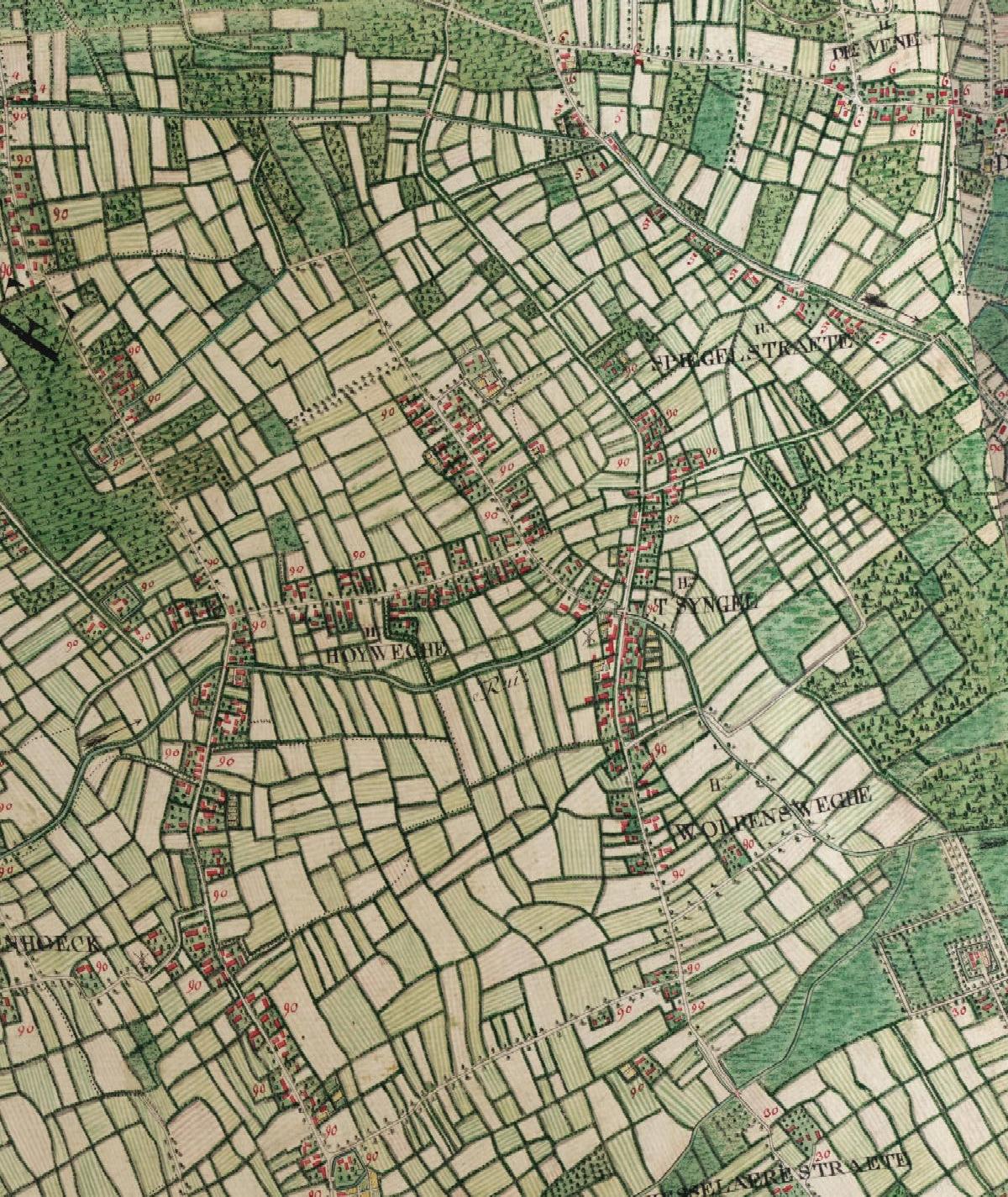
No house on it had a number in the seventeenth century, and the priests recorded only the road. But the road can be seen, eighty years after Livinus's death, on the great map of the Austrian Netherlands made under Count de Ferraris in the 1770s. There it runs through the fields east of the village, lined with small red-roofed houses, each in its own green plot, with a windmill drawn beside it near the hamlet of 't Syngel. Across the fields to the east, the engraver wrote the name of the hamlet: Hau Wolpensweghe, the hamlet of the Volpenswege.14
A wedding in the autumn of 1655
On 12 October 1655, Livinus Saij and Maria Kerbrock came before the priest of Sint-Joris and were betrothed. Their banns were called on the 17th, the 24th and the 28th of October, and on 21 November they were married, "in the presence of Adrianus van Belle and Guilhelmus Kesel".15
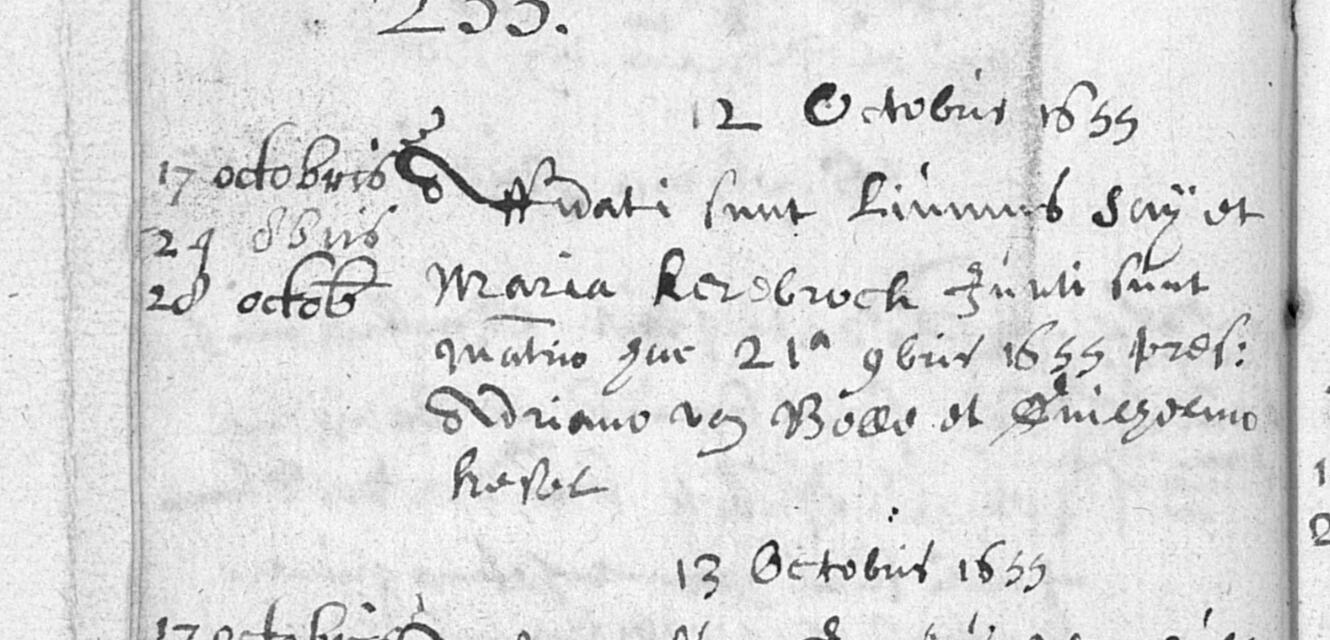
Transcription and translation
12 Octobris 1655 — Affidati sunt Livinus Saij et Maria Kerbrock. Juncti sunt matrimonio hac 21a 9bris 1655. pres[entibus]: Adriano van Belle et Guilhelmo Kesel. [margin: 17 octobris, 24 8bris, 28 octob.]
12 October 1655. Livinus Saij and Maria Kerbrock were betrothed. They were joined in marriage on 21 November 1655, in the presence of Adrianus van Belle and Guilhelmus Kesel. (In the margin: the banns, read on 17, 24 and 28 October.)
The entry is brief, as most were. It gives no parents and no place of origin for either of them, and it does not call Livinus a widower. He was twenty-seven or twenty-eight. Maria was a few years older: she was sixty-five when she died in 1688, and so was born about 1623, and was about thirty-two at her wedding.16
Her surname was spelled differently almost every time it was written: Kerbrock, Kerebrock, Kerrebrouck, Kerrebroeck, Van Kerrebroeck.17 Her baptism has not been found, but the inventory of her estate names her father: she was "Maeyken van Kerrebrouck fa Franchoijs", daughter of Franciscus, which explains why two of her sons were called Franciscus.29 Her family can be glimpsed around her. A Gerardus Van Kerrebrouck had married Margareta Steenbeke at Sleidinge in 1637. Margareta stood godmother to Livinus and Maria's son Joannes in 1660, and Gerardus godfather to their son Livinus in 1664. Gerardus was very probably Maria's brother. A Magdalena Kerrebroeck and a Joanna Kerbrock, godmothers to two of the later children, were probably her sisters or cousins.18
Seven children
Between 1658 and 1673 Maria gave birth to seven children. Each was carried to Sint-Joris within a few days of birth to be baptised.19
The first was Jacoba, born on 2 June 1658 at nine in the evening. Her godfather was Adrianus van Belle, who had witnessed her parents' wedding.
Between her baptism and the next, the parish changed its patron in all but name. In 1659 the relics of Saint Godelieve were brought to Sleidinge from the Klein Begijnhof at Ghent, and her cult soon overshadowed that of Saint George himself. From then on the registers of the parish are headed Sint-Joris en Sint-Godelieve, which is how the State Archives still catalogue the books this history is built on.20 Four years later, in 1663, a new font of coloured marble was set up, cut by the Ghent master Jacques Cot.20 Joannes, in 1660, was christened at the old font; the four children who came after him were the first of this family to be held over the new one.
The second was Joannes, born on 18 June 1660 at about two in the morning. His baptism is one of the few entries for this family that have been read in the original register, and it holds the family together:
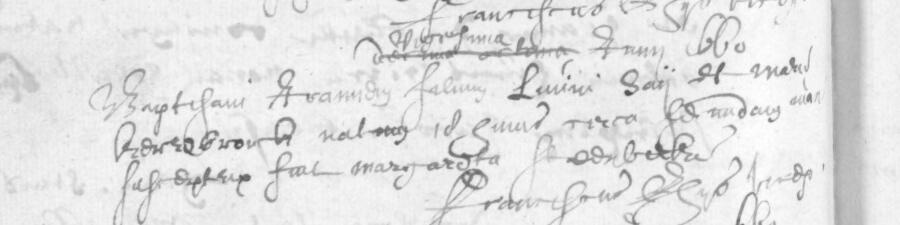
Transcription and translation
[decima octava struck out] Vigesima Junii 1660 — Baptisavi Joannem filium Livini Saij et Mariae Kerrebrouck natum 18 Junii circa secundam … susceptrix fuit Margareta [Steenbeke]. Franciscus Ghys[?]
20 June 1660 (the priest first wrote the 18th and corrected it). I baptised Joannes, son of Livinus Saij and Maria Kerrebrouck, born on 18 June at about two o'clock. The godmother was Margareta Steenbeke.
Baptisavi Joannem filium Livini Saij et Mariae Kerrebrouck natum 18 Junii circa secundam … susceptrix fuit Margareta Steenbeke. "I baptised Joannes, son of Livinus Saij and Maria Kerrebrouck, born on the 18th of June at about two o'clock … the godmother was Margareta Steenbeke." The priest began to head the entry with the eighteenth, struck it out, and wrote the twentieth above: the child was born on the 18th and baptised on the 20th of June.21 It is this entry, together with his burial fifty-nine years later, that proves Joannes was Livinus's son. He carried the line on, and his life is told in chapter 2.
Then came Franciscus, born on 30 August 1662, who died on 21 July 1664, not yet a year old; Livinus, named after his father, born on 22 September 1664 at four in the morning; and Maria, born on 30 July 1667.22
Maria grew up, married Livinus Slabbaert at Sleidinge on 4 August 1691, and after his death married again, to Livinus Neyt. She died at Lovendegem, the next parish to the south-west, on 4 May 1728. Her burial entry there still names her as the daughter of Livinus.23
The sixth child, Magdalena, was born on 6 March 1670, with Magdalena Kerrebroeck as her godmother. The seventh, Franciscus, given the name of the brother who had died, was born on 8 May 1673.22
1673
The year 1673 is the hardest in the family's record. On 20 January, at six in the evening, Jacoba died. She was fifteen. On the morning of 8 May Maria gave birth to Franciscus, and the next day he was baptised. At nine o'clock that same morning, the day after his birth, his sister Magdalena died. She was three.24 Franciscus himself lived to the age of four: he died on 19 September 1676.24 Of the seven children, four died before they were grown.
The registers say nothing of why. But the years were hard ones, and the pastors of Sleidinge wrote as much in the margins of their baptism book. On 7 September 1667 Frans Staes noted that the French were laying waste the whole country. On 18 May 1673, nine days after Franciscus was baptised, a note records that the people of the parish were fleeing from the French, and no child was baptised again until 15 June. In the autumn of 1677 French troops set fire to a great many houses in Sleidinge.30 Peace with the Dutch had not brought peace to Flanders. From the 1670s the armies of Louis XIV of France fought their way through the southern Netherlands. French troops plundered Lochristi and Wachtebeke, east of Ghent, in 1675; the King besieged Ghent in 1678; in 1683 his soldiers destroyed the centre of Evergem, the next parish to the south; and in 1691 a French army camped at Doornzeledries and Kluizen, just to the east, and set fire to the country around.5 Among the estate papers of a Saey family at Kluizen is a guardians' request that mentions, in passing, a farmstead "burned down on 13 April 1676 by French troops".25
The last years
Maria Van Kerrebrouck died on the Volpenswege on 13 October 1688, at seven in the morning. She was sixty-five.26 Because one of her children was still under age, the court of the county of Evergem, to which this part of Sleidinge belonged, had an inventory of her estate drawn up, the staat van goed. It was completed on 13 July 1689. Livinus appeared as the widower, "Lieven Saeij fs Jan". His sons Jan and Lieven, both of age, appeared for themselves. Jan also acted as guardian of his sister Marie, then twenty-one and still a minor, together with a Van Kerrebrouck, son of Gheeraert, for her mother's side.29 Livinus lived ten years more. He saw two of his children married: Joannes in February 1690, and Maria in August 1691. In April 1691 he stood godfather, in the church where he had been married, to his first grandchild, a boy christened Livinus after him.27 His son Livinus never married. He was what the clerks called innocent: a grown man who could not look after himself, and who needed a guardian all his life. He lived on in the house on the Volpenswege, cared for by his brother Joannes, and died there on 20 February 1705, aged forty.28
He died at the start of a hungry year. In 1699 grain was so scarce and so dear in the villages of the Oudburg, and in Lovendegem, Sleidinge and Zomergem above all, that the authorities feared a rising of the poor.30 When old Livinus died, on that January morning in 1699, he had lived through the last twenty years of the Eighty Years' War, the Dutch occupation of his parish, and the wars of Louis XIV. He had buried his wife and four of his children. He left a son on the Volpenswege who would carry the family on in the same street for two more generations.
Three weeks after his death the court of Evergem drew up the inventory of his estate. It names him once more as "Lieven Saeij fs Jan", and it lists his heirs: his son Jan, for himself and as guardian of his brother Lieven, "an innocent orphan of full age", and Lieven Slabbaert, husband of his daughter Marie. It also mentions an older document, a division of property made on 10 April 1659 between Livinus and the heirs of a Jaecques Burrens. Who Jaecques Burrens was, and why Livinus shared an estate with his heirs three years after his wedding, is not known. It may be the best clue yet to where he came from, and it is taken up in chapter 4.31
-
Burial of Livinus Saey, Sleidinge, Sint-Joris parish, burial register 1682–1715, folio 109 [S3]. Read from the original register (grade A). ↩
-
The Sleidinge baptism index has no Livinus Say between 1612 and 1640 [S5]. The parish's second baptism book for 1619–1627 was read entry by entry from August 1623 to May 1627; it records two other Say baptisms on the dates the index gives, but no Livinus [S10] (grade A for the reading; a negative result). ↩
-
K. Lanclus and M. Verbeeck, Kantons Evergem en Lochristi, Inventaris Onroerend Erfgoed (1993) [S11]. ↩↩↩↩↩
-
A. De Vos, Oud Sleidinge (2), Ons Meetjesland 11 (1978), no. 3 [S103] (grade B). ↩↩
-
N. De Vijlder, The Rural Land Market in Early Modern Inland Flanders and Brabant, Rural History 29 (2018), pp. 121-122 [S104] (grade B). One of the article's four case studies is the county of Evergem itself. ↩↩
-
A. De Vos, "Op tocht door Sleidinge", Ons Meetjesland 8 (1975), no. 1 [S19]; the composition of the two benches and the acreages from Oud Sleidinge (2) [S103] and De Vijlder [S104]. ↩↩
-
K. Lanclus and M. Verbeeck, Sleidinge, Inventaris Onroerend Erfgoed (1993) [S12]. ↩
-
The sources differ on when the eastern part passed to the abbey: in 1248 according to De Vos [S19]; by a sale of the Van Gavere family in 1282 according to the Dutch Wikipedia and the heritage inventory [S12, S13]. ↩
-
K. Lanclus, Volpenswege, Inventaris Onroerend Erfgoed (1993) [S18]. ↩↩
-
Ferraris map (1777), from the historical-map service of Flanders [S20]. The map draws a windmill near 't Syngel; whether it is the abbey's mill named in the heritage inventory is not known. ↩
-
Betrothal and marriage, Sleidinge marriage register 1608–1682, folio 233 [S1]. Read from the original (grade A). The dates of the banns are written in the margin, and agree with the index [S7]. ↩
-
Maria's age at death, from the Sleidinge burial index [S6] (grade B); her birth year is derived from it (grade C). ↩
-
The spellings come from the marriage [S1], the baptisms of her children [S5] and her burial [S6]. ↩
-
The 1637 marriage and the godparents come from the Sleidinge indexes [S5, S7] and the 1660 baptism [S2]. That Gerardus was her brother is an inference from the choice of godparents (grade C). ↩
-
All seven baptisms are in the Sleidinge baptism index, with the hour of birth where the priest recorded it [S5] (grade B). Birth and baptism are never more than four days apart. ↩
-
A. De Vos, Oud Sleidinge (2) [S103] (grade B): the translation of the relics in 1659 and the font of 1663 by Jacques Cot of Ghent. That the younger children were baptised at the new font follows from the dates (grade C). ↩↩
-
Baptism of Joannes, Sleidinge baptism register 1643–1660, folio 405 [S2]. Read from the original (grade A). ↩
-
First marriage: Sleidinge marriage index [S7]. Second marriage and burial: Lovendegem burial index, "daughter of Livinus, widow of Livinus Neyt" [S8] (grade B). A compiled genealogy gives the second wedding as 4 May 1708 [S9], the same day and month as her death, which may be a copying slip. ↩
-
Sleidinge baptism and burial indexes, with the hours the priest recorded [S5, S6] (grade B). ↩↩
-
Estate inventories of the Ambacht Assenede, request of 8 October 1676 [S14] (grade B). The abstract does not say where the farm stood. ↩
-
Sleidinge burial index: "Maria Van Kerrebroeck, 13/10/1688 (07:00), partner Saey Livinus, 65 years, Volpenswege" [S6] (grade B). ↩
-
Sleidinge marriage index [S7]; baptism index, "godfather Saey Livinus", 20 April 1691 [S5] (grade B). ↩
-
Sleidinge burial index, 20 February 1705: "Livinus Say, unmarried, 40 years, Volpenswege" [S6]. The entry names no parents, but the estate inventories of 1699 and 1706 name "Lieven Saeij fs Lieven" as an innocente weese and describe how his brother Jan had kept him "for many years" [S79] (grade B). ↩
-
Estate inventory (staat van goed) of Maeyken van Kerrebrouck, died Sleidinge-Sint-Baafs, Volpenswege, October 1688, completed 13 July 1689. Abstract in L. Neyt, De staten van goed van het Graafschap Evergem, vol. VI, 1612–1693 (1995), no. 955 [S77] (grade B); original in the State Archives, Ghent, Graafschap Evergem, bundle 281. The Volpenswege lay in the part of the parish called Sleidinge-Sint-Baafs, under the court of the Graafschap Evergem [S78]. Working file:
evidence/svg_1688_maria_van_kerrebrouck.md. ↩↩↩ -
A. De Vos, "De bevolkingsevolutie van Evergem, Lovendegem, Sleidinge, Waarschoot en Zomergem gedurende de XVIIe en XVIIIe eeuwen", Appeltjes van het Meetjesland 8 (1957), citing the marginal notes in the Sleidinge baptism register and the records of the Oudburg, pp. 40-45 [S78]. ↩↩
-
Estate inventory of Lieven Saeij fs Jan, died Sleidinge-Sint-Baafs, Volpenswege, 20 January 1699, dated 11 February 1699: L. Neyt, De staten van goed van het Graafschap Evergem, vol. V, no. 520 [S79] (grade B). Working file:
evidence/svg_evergem_saeij_chain.md. ↩