Chapter 7. Judocus Bernardus Saeij, day labourer of Bassevelde, 1777 to 1831
A Sleidinge boy
Judocus Bernardus was born at Sleidinge at half past five in the afternoon of 17 August 1777, the sixth of Bernardus and Maria Anna's ten children, and baptised at Sint-Joris the next day. His godfather was Petrus Franciscus Van Hyfte, probably one of his mother's family.1 The civil acts of his later life all give his birthday as the 18th, the day of his baptism.2
He spent his childhood in the Sleidinge described in chapter 6 and was in his teens when the French armies came. By the time he was twenty-two the family had moved north to the Kaprijke district, near the Dutch border. His sister was a spinner at Bassevelde by 1800, and he too was living there by 1802.3 He would spend the rest of his life in that village.
Bassevelde
Bassevelde lies about four kilometres east of Kaprijke, on the edge of the polders. It is an old village, first mentioned in the tenth century. In the Middle Ages it belonged to the Ambacht Boekhoute, one of the Four Ambachten, the medieval districts of northern Flanders. The grasslands around it and the nearness of Ghent, the great cloth town, made it a place of wool, until it lost its share of the cloth trade, probably to Ghent itself.4 North of the village runs the old sea dyke, the Graaf Jansdijk, part of which is called the Landsdijk. Beyond it lie the reclaimed polders and, some kilometres further north, the border with Dutch Flanders. The family would live along that dyke in the next generation.5
The wedding of year X
On 1 Thermidor of the year X of the French Republic, 20 July 1802, Judocus Bernardus Saey, twenty-four years old, married Anna Marie Bolangiers at Bassevelde.6
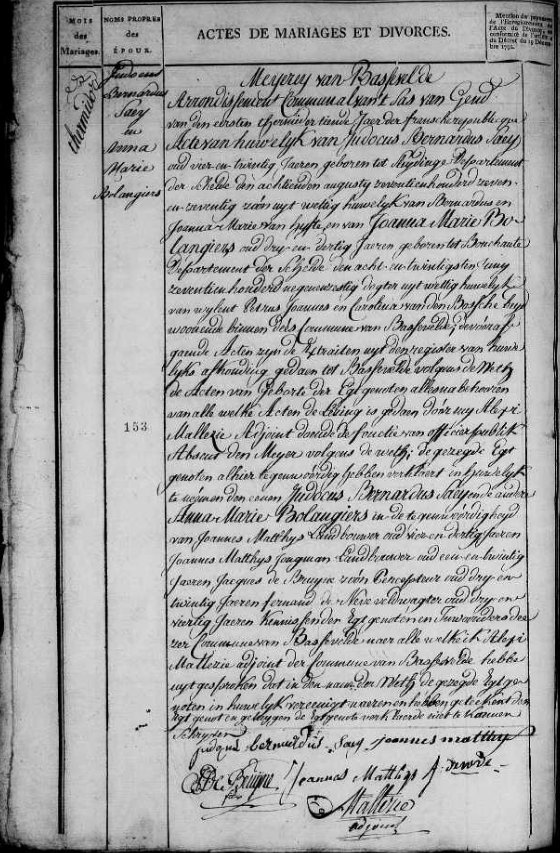
Transcription and translation
Meyery van Bassevelde. Arrondissement Communael van 't Sas van Gend. van den eersten Thermidor tiende Jaer der fransche republique. Acte van huwelyk van Judocus Bernardus Saey oud vier-en-twintig Jaeren geboren tot Sleydinge Departement der Schelde den achttienden augusty zeventienhondert zeven-en-zeventig zoon uyt wettig huwelyk van Bernardus en Joanna Marie van Hyfte, en van Joanna Marie Bolangiers oud dry-en-dertig Jaeren geboren tot Boechaute Departement der Schelde den acht-en-twintigsten Juny zeventienhondert negen-en-zestig dogter uyt wettig huwelyk van wylent Petrus Joannes en Carolina van den Bossche, beyde woonende binnen deze Commune van Bassevelde ... de Egtgenoote verklaerde niet te konnen schryven.
Mayoralty of Bassevelde, communal arrondissement of Sas van Gent. 1 Thermidor, year X of the French Republic [20 July 1802]. Marriage act of Judocus Bernardus Saey, aged 24, born at Sleidinge, department of the Scheldt, on 18 August 1777, son of the lawful marriage of Bernardus and Joanna Marie van Hyfte; and of Joanna Marie Bolangiers, aged 33, born at Boekhoute, department of the Scheldt, on 28 June 1769, daughter of the lawful marriage of the late Petrus Joannes and Carolina van den Bossche, both living in this commune of Bassevelde ... The bride declared that she could not write.
The heading of the act is a reminder of how far the old borders had dissolved. Meyery van Bassevelde, Arrondissement Communael van 't Sas van Gend: the mayoralty of Bassevelde, in the arrondissement of Sas van Gent. Sas van Gent was a fortress town of Dutch Flanders, on the far side of what had been the border since 1648. It was now the seat of a French arrondissement that took in Flemish villages too.7
The bride was thirty-three, eight years older than her husband. She had been born at Boekhoute, a few kilometres to the north-east, on 28 June 1769. Her father, Petrus Joannes Bolangiers, was dead, and her mother was Carolina van den Bossche.6 The mayor was away, so his deputy, Mallezie, read out the papers: the proof that the banns had been published and the birth records of the couple. The witnesses were two farmers, both named Joannes Matthys, a young man called Jacques de Bruyne, and the village field guard. The act ends with a sentence that comes back again and again in these records: the bride verklaerde niet te konnen schryven, "declared that she could not write". Judocus could. He signed judocus bernardus Saey.6
Three sons, and a grandfather
Nine months later, at five in the afternoon of 25 April 1803, their first son was born. The next day Judocus registered him with the mayor, Jacques Audenaerde, who wrote the act:
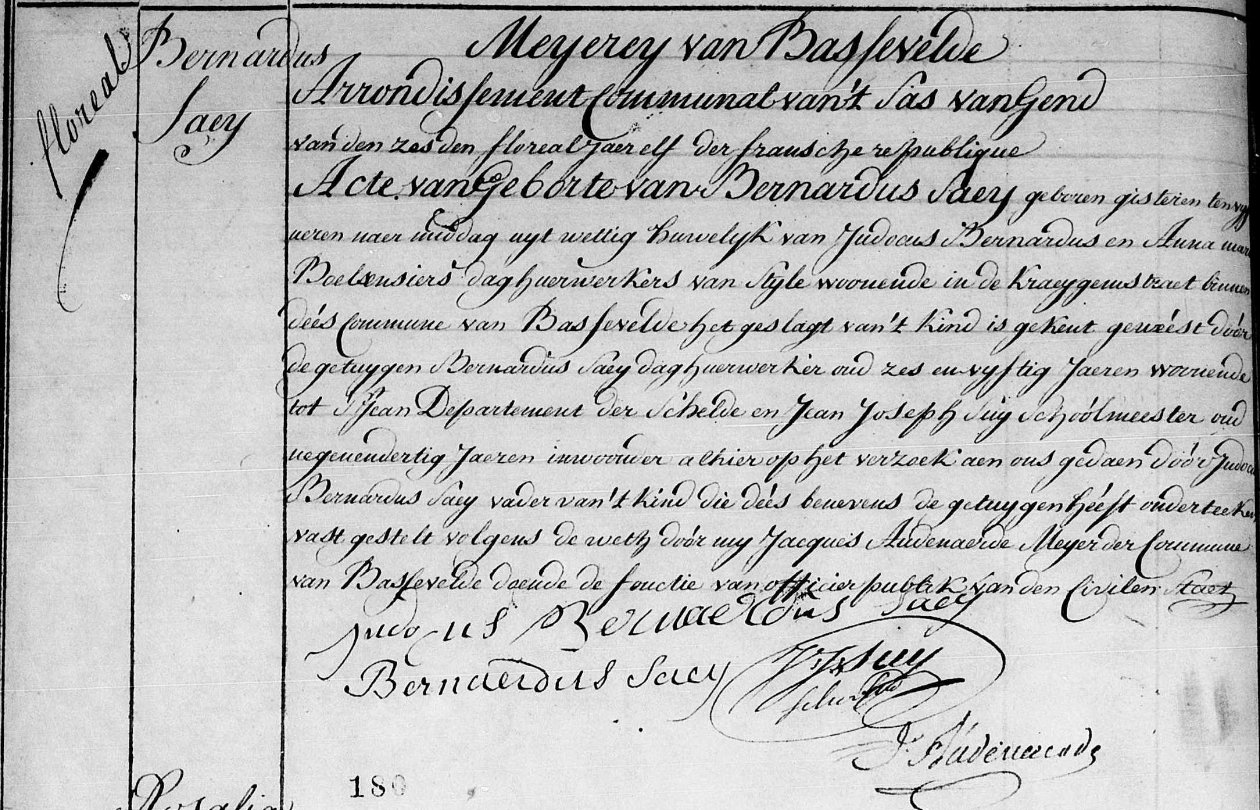
Transcription and translation
Meyerey van Bassevelde. Arrondissement Communal van 't Sas van Gend. van den zesden floreal Jaer elf der fransche republique. Acte van Geborte van Bernardus Saey geboren gisteren ten vyf ueren naer middag uyt wettig huwelyk van Judocus Bernardus en Anna Marie Boelensiers daghuerwerkers van Style woonende in de Kraeygemstraet binnen dees Commune van Bassevelde. Het geslagt van 't kind is gekent geweest door de getuygen Bernardus Saey daghuerwerker oud zes en vyftig jaeren woonende tot St Jean Departement der Schelde en Jean Joseph Suy schoolmeester oud negen en dertig jaeren inwoonder alhier; op het verzoek aen ons gedaen door Judocus Bernardus Saey vader van 't kind die dees benevens de getuygen heeft onderteekent. Vastgestelt volgens de wet door my Jacques Audenaerde Meyer der Commune van Bassevelde doende de functie van officier publiek van den Civilen Staet.
Mayoralty of Bassevelde, communal arrondissement of Sas van Gent. 6 Floréal, year XI of the French Republic [26 April 1803]. Birth act of Bernardus Saey, born yesterday at five in the afternoon, of the lawful marriage of Judocus Bernardus and Anna Marie Boelensiers, day labourers by trade, living in the Kraeygemstraat in this commune of Bassevelde. The sex of the child was verified by the witnesses Bernardus Saey, day labourer, aged 56, living at St Jean, department of the Scheldt, and Jean Joseph Suy, schoolmaster, aged 39, an inhabitant of this place; at the request of Judocus Bernardus Saey, the child's father, who signed this with the witnesses. Recorded according to the law by me, Jacques Audenaerde, mayor of Bassevelde, acting as civil registrar.
The baby was named Bernardus, like his grandfather. His parents are described as daghuerwerkers van style, day labourers by trade, living in the Kraeygemstraet. The street is still there under its modern spelling: the Kraaigemstraat runs south from Bassevelde towards Oosteeklo. The act gives no house number.8
One of the two witnesses was "Bernardus Saey, day labourer, aged fifty-six, living at St Jean", and his signature, Bernardus Saey, stands below the father's. He may well have been the baby's grandfather. Bernardus of Sleidinge was then fifty-five, and a year's error in an age is nothing unusual. But there were other Saey families around Bassevelde, and the act does not say. St Jean would be Sint-Jan-in-Eremo, about seven kilometres to the west. If it was he, it is the only glimpse we have of him between Sleidinge and his death at Kaprijke six years later, and it shows that he could write.9 The other witness was the village schoolmaster, Jean Joseph Suy, who would witness the next two births as well.
The second son was born at half past ten on the night of 9 January 1805. By now the clerks wrote in French, and the act calls the father Josse Bernard Saey, twenty-six, journalier, a day labourer. The boy was named Jean François, and the first witness was a Jean François Claeys, a day labourer of Oost-Eeklo, aged twenty-nine. This was almost certainly Bernardina Coleta's husband, the baby's uncle, who had married her in the Temple of the Law five years before.10 A third son followed at seven in the morning of 3 October 1806. He was registered as Ange, "a child of the male sex", born to a father who now lived in the Beekstraat, another Bassevelde street that still carries the name. Twenty-six years later, when he married, the same man called himself Engelbertus, with the same birthday and the same parents. The French Ange and the Flemish Engelbert were one person.11
Emperor, then king
The children were born citizens of France. Napoleon had crowned himself emperor in 1804, and in 1806 the Republic's calendar was dropped and the acts went back to ordinary dates.12 Then, in 1814, the empire collapsed. After Napoleon's final defeat the great powers joined the old Austrian Netherlands to the Dutch provinces in a new state, the United Kingdom of the Netherlands, under King William I.13 For fifteen years the border between Flemish Bassevelde and Dutch Zeeland was only a provincial boundary within one kingdom. The records turn back to Dutch, and in place of the French department their headings now read district Eecloo, provincie Oostvlaenderen. The young men of the villages were enrolled in the Dutch national militia, as Jean François was in the class of 1824.14
Judocus's trade is given as daghuerwerker in 1803, journalier in 1805 and 1806, landsman (countryman) in 1821 and werkman, workman, in 1827.15 Together they describe a man who worked on the land for others, by the day. His second wife, her mother, his sister and later his daughter-in-law were all spinners. Hand-spun Flemish flax yarn was one of the great cottage industries of the region, and it was about to be ruined. Around 1830 the machine-spun yarn of Britain made it uncompetitive, and the almost 220,000 spinners still working at home in Flanders were thrown into poverty.16
Widower, and a second wife
Anna Marie Bolangiers died at Bassevelde on 8 March 1821, aged fifty-one.17 Judocus was forty-three, with three sons aged between fourteen and seventeen. Nearly nine months later, on 30 November 1821, at three in the afternoon, he married again.
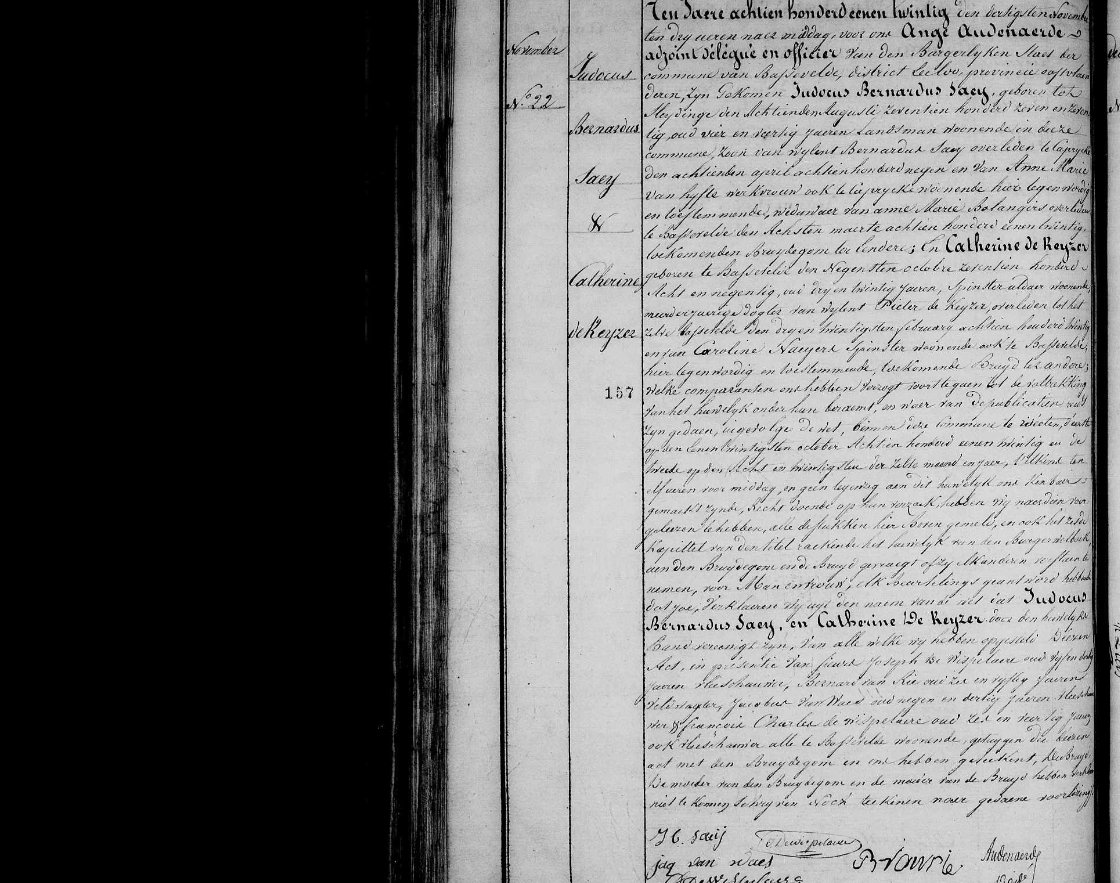
Transcription and translation
Ten Jaere achttien honderd eenen twintig den dertigsten November ten dry ueren naer middag, voor ons Ange Audenaerde adjoint délégué en officier van den Burgerlyken Staet der commune van Bassevelde ... zyn gekomen Judocus Bernardus Saey, geboren tot Sleydinge den achttienden Auguste zeventien honderd zeven en zeventig, oud vier en veertig jaeren, landsman woonende in deze commune, zoon van wylent Bernardus Saey overleden te Caprycke den achttienden april achttien honderd negen, en van Anne Marie van Hyfte werkvrouw ook te Caprycke woonende, hier tegenwoordig en toestemmende, weduwnaer van Anne Marie Bolangers overleden te Bassevelde den achtsten maerte achttien honderd eenen twintig ... en Catherine de Keyzer geboren te Bassevelde den negentienden octobre zeventien honderd acht en negentig, oud dry en twintig jaeren, spinster aldaer woonende ... de Bruyd, de moeder van den Bruydegom en de moeder van de Bruyd hebben verklaerd niet te konnen schryven noch teekenen naer gedaene voorlezing.
On 30 November 1821 at three in the afternoon, before Ange Audenaerde, deputy and civil registrar of Bassevelde ... came Judocus Bernardus Saey, born at Sleidinge on 18 August 1777, aged 44, a countryman living in this commune, son of the late Bernardus Saey, who died at Kaprijke on 18 April 1809, and of Anne Marie van Hyfte, a labouring woman also living at Kaprijke, here present and consenting; widower of Anne Marie Bolangers, who died at Bassevelde on 8 March 1821 ... and Catherine de Keyzer, born at Bassevelde on 19 October 1798, aged 23, a spinner living there ... The bride, the groom's mother and the bride's mother declared, after the act had been read, that they could neither write nor sign.
His bride was Catherine de Keyzer, twenty-three years old, a spinner, born at Bassevelde on 19 October 1798, the daughter of the late Pieter de Keyzer and of Caroline Naeyert, also a spinner. Both mothers were there and gave their consent: Catherine's, and Judocus's own mother, Maria Anna van Hyfte, a labouring woman of Kaprijke, in what is the last record we have of her. The banns had been read on two Sundays in October, at eleven in the morning. The witnesses were three butchers of the village and the field guard. At the end the clerk wrote that the bride, the groom's mother and the bride's mother could neither write nor sign. The groom signed J B Saeij.18 No children of this second marriage have been found in the records we have seen.
The first tie to Zeeland
In October 1827 Jean François, now written Joannes Franciscus Saeij and a labourer like his father, married at Bassevelde. His bride, Theresia Carolina De Roo, was a spinner born at Watervliet. Her father was dead, and her mother was a labouring woman living at IJzendijke, across the border in the Dutch province of Zeeland. So the banns were read twice: on two Sundays at Bassevelde, and on the same two Sundays at IJzendijke. Judocus came to give his consent and signed the act. The certificate from the Governor showed that the groom, although enrolled in the militia of 1824, had not been required to serve.19 It is the earliest link between this family and IJzendijke that we have found. Some fifty years later IJzendijke would be the home of Judocus's grandson.
Revolution, and the end
In August 1830 revolution broke out in Brussels. On 4 October the provisional government declared Belgium independent, and on 21 July 1831 Leopold of Saxe-Coburg took the oath as the first King of the Belgians. In August 1831 the Dutch king sent his army to win the south back. The campaign lasted ten days and was ended by French intervention.20 The new frontier between Belgium and the Netherlands followed the old one of 1648 through the Four Ambachten, so Bassevelde became a Belgian border village. The Dutch king did not recognise Belgium until 1839.21
Judocus Bernardus did not see much of the new kingdom. He died at Bassevelde on 21 September 1831, aged fifty-four, two months after the first king took his oath.22 His death act has not yet been read. The date comes from the marriage of his son Engelbertus the following June.
The three sons stayed at Bassevelde as labourers. Engelbertus married a maidservant, Amelia de Kryger, in 1832, and in 1870, in his sixties, he was still a farm labourer there. Unlike his father, he had never learned to write his name.23 The eldest, Bernardus, is the next link in the chain.
-
Sleidinge baptism index, 17 August 1777 (17:30), baptised 18 August; godparents Petrus Franciscus Van Hyfte and Isabella Theresia Van De Veire (record 225245) [S5] (grade B). ↩
-
Marriage acts of 1802 and 1821, both "born at Sleidinge on 18 August 1777" [S48, S49] (grade A). ↩
-
Marriage of Bernardina Coleta, 1800, "living at Bassevelde" [S47]; marriage of Judocus Bernardus, 1802, "both living in this commune of Bassevelde" [S48] (grade A). ↩
-
Inventaris Onroerend Erfgoed, Dorpskern Bassevelde (2021) [S51]. The distance is measured on a modern map. ↩
-
C. Bogaert and K. Lanclus, Landsdijk, Inventaris Onroerend Erfgoed (2005) [S56]. See chapter 8. ↩
-
Marriage of Judocus Bernardus Saey and Anna Marie Bolangiers, Bassevelde, act 153, 1 Thermidor year X [S48]. Read from the image (grade A). The act gives the bride's first names as both Joanna Marie and Anna Marie. The year X began on 23 September 1801, so the date is 20 July 1802; the family's files and FamilySearch say 1801, which the ages in the act rule out. Working file:
evidence/gen07.md. ↩↩↩ -
Escaut (department), Wikipedia (French) [S41], and context note 3. ↩
-
Birth of Bernardus Saey, Bassevelde, act 180, 6 Floréal year XI [S57]. Read from the image (grade A). The street was located on a modern map (OpenStreetMap). House numbers are not given in these acts. ↩
-
Same act [S57]. That the witness was the child's grandfather is our inference from the name, the age (56 for 55) and the trade (grade C). His residence reads "St Jean"; Sint-Jan-in-Eremo is the nearest parish of that name. ↩
-
Birth of Jean François Saey, Bassevelde, 20 Nivôse year XIII (10 January 1805) [S57] (grade A). Joannes Franciscus Claeys of Oost-Eeklo, born 15 August 1775, married Bernardina Coleta Saeij in 1800 [S47]; that he is the witness is an inference (grade C). The father's age of 26 is a year short. ↩
-
Birth of Ange Saey, Bassevelde, act 43, 3 October 1806; marriage of Engelbertus Saey, Bassevelde, act 7, 6 June 1832, "born here on 3 October 1806", son of Judocus Saey and Anne Marie Bolensiers [S57] (grade A). FamilySearch lists "Ange" as a girl and Engelbert separately; both are errors. ↩
-
Marriage of Joannes Franciscus Saeij, Bassevelde, act 45, 27 October 1827 [S57] (grade A); marriage of 1821 [S49] for the new heading. ↩
-
Civil acts of 1803, 1805, 1806, 1821 and 1827 [S48, S49, S57] (grade A). ↩
-
Her death date is given in three later acts: 8 March 1821 (1821 and 1827) and 10 March 1821 (1832) [S49, S57] (grade A for the statements; her death act has not been read). Her age is derived from her birth on 28 June 1769 (grade C). ↩
-
Second marriage of Judocus Bernardus Saey and Catherine de Keyzer, Bassevelde, act 22, 30 November 1821 [S49]. Read from the image (grade A). The bride's mother's surname is not fully certain (Naeyert?). ↩
-
Marriage of Joannes Franciscus Saeij and Theresia Carolina De Roo, 27 October 1827 [S57] (grade A). ↩
-
Treaty of London (1839), Wikipedia [S54]; Borders of Belgium, Wikipedia [S53]. ↩
-
Stated in the marriage act of Engelbertus Saey, 6 June 1832 [S57] (grade A for the statement). ↩
-
Marriage of Engelbertus Saey and Amelia de Kryger, 1832; death of Marie Therese Vervaet, Bassevelde, act 49, September 1870, reported by "Engelbertus Saey, aged sixty-five, farm labourer" (he was in fact sixty-three), who declared that he could not sign, "never having learned" [S57] (grade A). ↩