Chapter 3. Joannes Saey and Georgia Stofferis, 1706 to 1770
A child of the second marriage
On a December evening in 1706, at about seven o'clock, Jacoba Kerckaert gave birth to a son. The family was living on the Volpenswege.1 Ten months earlier her first baby had died a day after he was born. This one lived. The next day, a Thursday, he was carried to Sint-Joris, where the vice-pastor, P. Verspreet, baptised him and wrote in the register:
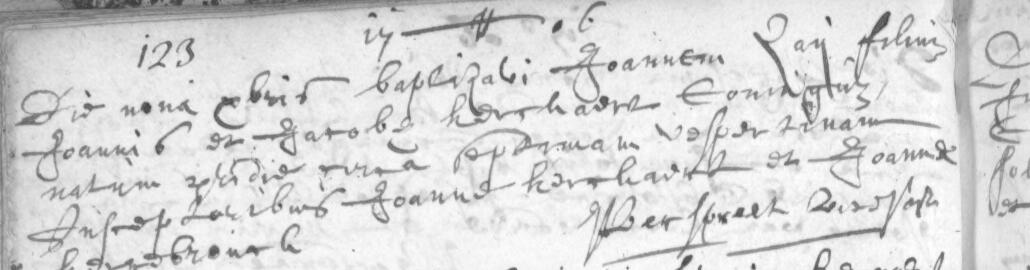
Transcription and translation
[1706] Die nona xbris baptizabi Joannem Zaij filium Joannis et Jacobae Kerkhaert conjugum natum pridie circa septimam vespertinam susceptoribus Joanne Kerkhaert et Joanna Kerrebrouck. P. Verspreet vicepast.
On 9 December (1706) I baptised Joannes Zaij, son of Joannes and Jacoba Kerkhaert, a married couple, born the day before at about seven in the evening. Godparents Joannes Kerkhaert and Joanna Kerrebrouck. P. Verspreet, vice-pastor.
Die nona xbris baptizabi Joannem Zaij filium Joannis et Jacobae Kerkhaert conjugum natum pridie circa septimam vespertinam: "On 9 December I baptised Joannes Zaij, son of Joannes and Jacoba Kerkhaert, a married couple, born the day before at about seven in the evening." His godparents were Joannes Kerckaert, probably his mother's father, and Joanna Kerrebrouck.1 The priest spelled the surname with a Z. Every clerk wrote the name as he heard it, and it was that Z that at first hid this entry from the research for this history.
Joannes came into a country at war. In the two years after his birth the French took Ghent, the Duke of Marlborough took it back, and the Great Frost of 1709 followed, as chapter 2 told. His father was forty-six, a widower with children from his first marriage, and brothers and sisters of his own came in quick succession: Joanna in 1708, Franciscus in 1710, Livinus in 1712, and Petrus in 1716. Two little sisters, Anna Maria and Christophora, died as small children.2
His father died on 5 April 1719, when Joannes was twelve. His mother, Jacoba Kerckaert, was left with at least four children still at home, and in June 1722, when Joannes was fifteen, she married Cornelius Leuris.3 Cornelius was to stand beside Joannes at his wedding, and at the font for one of his sons.
The Austrian peace
The boy grew up in a new state. The treaties that ended the War of the Spanish Succession in 1713 and 1714 had handed the southern Netherlands from the Spanish branch of the Habsburg family to the Austrian one. Sleidinge was now in the Austrian Netherlands, governed from Brussels in the name of the emperor in Vienna.4 There followed nearly thirty years of peace in Flanders. The countryside around Ghent grew more crowded and a little more prosperous. The population rose, farms were divided into ever smaller holdings, and small new farmhouses went up for tenant farmers. The historians of the heritage inventory write of building on a scale the countryside had never seen before.5 In Sleidinge the weaving of linen was a household trade, all through the eighteenth century and into the nineteenth.6 About 1722 the bishop's visitor, De Castillon, counted more than two thousand communicants in the parish: everyone over twelve, that is, who was obliged to take Easter communion. They were served by one pastor, one assistant and one sexton.7
The crowding can be counted, because the county of Evergem is one of the four places a recent study of the rural land market examined in detail. Its people per square kilometre rose from 49 in the fifteenth century to 72 in the sixteenth, 93 in the seventeenth and 156 in the eighteenth: the parish Joannes grew up in held twice as many people as the one his great-grandfather had known. And the land was going the other way. Holdings of under three hectares — the cottar's plot, too small to live on — made up 24.8 per cent of the county in 1587 and 76.26 per cent by 1790. Meanwhile the average sale of arable land in the county grew by more than half, from 0.97 hectares in the sixteenth century to 1.53 in the eighteenth, because what changed hands was increasingly whole farms bought by people with capital. By the middle of the eighteenth century most of the woodland in the county belonged to burghers of Ghent.8
The consequence, the study says, was that a young man who wanted a farm of his own could no longer buy one, and "postponed" it: he worked as a day-labourer or farmhand and saved, or waited for a share of his parents' holding. That sentence describes this family for the next four generations. Joannes's son, grandson and great-grandson were all day labourers, and not one of them is recorded as owning the ground he worked.8
The other face of the same process stood a few kilometres to the east, at Wippelgem in Evergem, where two moated manors had been in the hands of Ghent patricians for centuries: Goed ten Broeke, held by the Borluut family from the thirteenth century and turned in 1531 into a huys van plaisance with a dovecote of two hundred and twenty nesting boxes, and Goed ten Hulle, first named in 1375. Neither has any connection with this family. They are simply what the other end of the land market looked like.9 The registers do not tell us what Joannes did for a living.
The wedding, September 1734
On Saturday 18 September 1734 Joannes, twenty-seven years old, came before the pastor of Sint-Joris with Georgia Stofferis and they were betrothed. Their banns were read three times: on Sunday the 19th, on Tuesday the 21st, the feast of Saint Matthew, and on Sunday the 26th. On Tuesday 28 September 1734 they were married.10
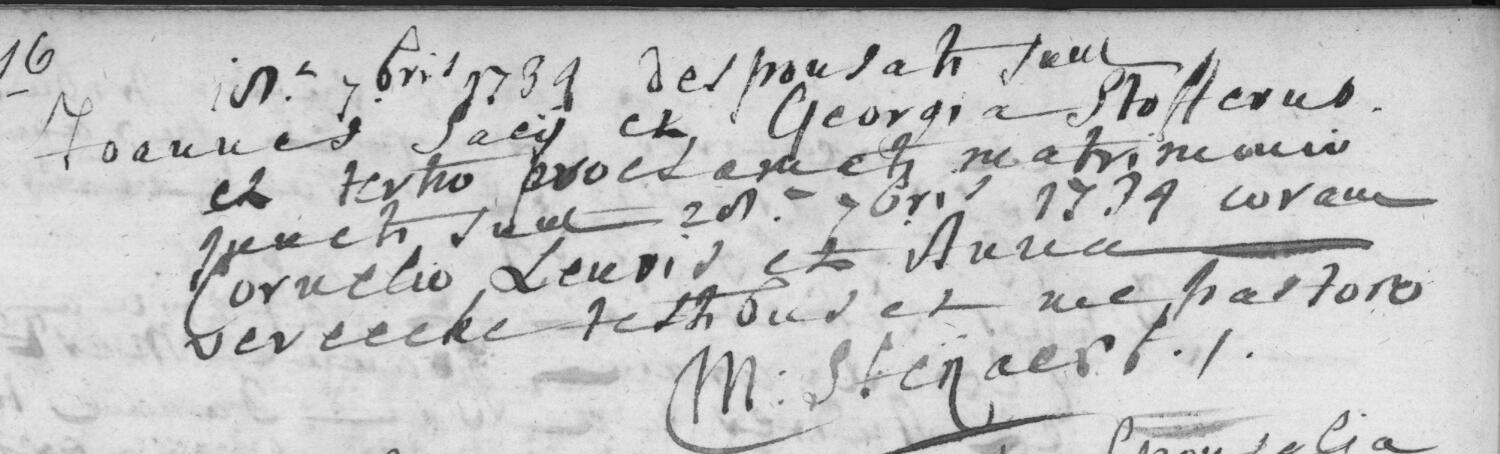
Transcription and translation
[margin: 19, 21, 26] 18 7bris 1734 desponsati sunt Joannes Saey et Georgia Stofferus et tertio proclamati matrimonio juncti sunt 28 7bris 1734 coram Cornelio Leuris et Anna Vereecke testibus et me pastore. M. Steyaert
On 18 September 1734 Joannes Saey and Georgia Stofferus were betrothed; after the third banns they were married on 28 September 1734, before Cornelius Leuris and Anna Vereecke as witnesses and me, the pastor. M. Steyaert.
18 7bris 1734 desponsati sunt Joannes Saey et Georgia Stofferus et tertio proclamati matrimonio juncti sunt 28 7bris 1734 coram Cornelio Leuris et Anna Vereecke testibus et me pastore. M. Steyaert: "On 18 September 1734 Joannes Saey and Georgia Stofferus were betrothed; after the third banns they were joined in marriage on 28 September 1734 before Cornelius Leuris and Anna Vereecke as witnesses, and me, the pastor. M. Steyaert." It is the form the Council of Trent had laid down more than a century and a half before: a marriage was valid only if it took place before the parish priest and two or three witnesses, after the banns had been read.11 The first witness was Joannes's stepfather.
Georgia was about the same age as her husband: she was sixty-three when she died in December 1770. Her father was called Georgius.12 Her baptism is not in the Sleidinge index, so she may have been born in a neighbouring parish. But the Stofferis family was an old one in Sleidinge. Stofferis mothers bring children to the font there from the 1620s on, and the name Georgius or Georgia recurs among them.13
Five sons
The first son, Carolus, was born on 5 February 1735, at half past two in the afternoon, and baptised the next day. His godmother was a Joanna Stofferus.14 Very probably this was the Joanna Stofferis who had married Joannes Van De Veire. That couple had a son baptised at Sleidinge on 7 October 1734, nine days after the Saey wedding, and in the years that followed the two young households stood godparent to each other's children. Joannes Saey was godfather to their son Judocus in February 1737, and Joannes Van De Veire was godfather to a Saey boy two years later.15
Cornelius was born on 21 February 1737, at eleven in the morning. His godfather was Cornelius Leuris, and his godmother Anna Vereecken, almost certainly the Anna Vereecke who had been the second witness at the wedding.14 Nine days later Joannes was himself a witness when his brother Livinus married Joanna Lippens.16
Joannes Franciscus was born at half past four in the morning of 26 April 1739, and the birth was evidently a dangerous one. A woman named Petronilla Boelens baptised him while he was being born, as the Church allowed anyone to do when a baby might die before a priest could be fetched. He survived the birth. His godparents, named in the register the same day, were Joannes Van De Veire and his grandmother, Jacoba Kerckaert.17
On 5 December 1742, at half past twelve, a fourth son was born and named Bernardus. His godparents were Joannes Stofferis and Joanna Saey.14 The godmother may have been Joannes's sister Joanna, born in 1708. A Joanna Saey was godmother to two children of his brother Petrus in the 1740s, but the index does not say who she was.18
Then came losses. Jacoba Kerckaert died on 12 July 1743, aged sixty-two, in the Wellinckstraat. Her grandson Bernardus died on 2 August 1744, not yet two years old. His burial entry places the family, as so often before, on the Volpenswege, and it is the last time the registers do so.19 Joannes's brother Petrus, living on the Hooiwege, lost his first wife in 1742 and several of his children as babies. In October 1744 Joannes stood godfather to one of Petrus's sons, Joannes Franciscus.20
The French in Flanders, 1745 to 1748
In 1740 the emperor Charles VI died without a son. His daughter Maria Theresa claimed all his lands, and most of the great powers of Europe went to war over her right to succeed him: the War of the Austrian Succession.21 The French had overrun much of western Flanders in 1744. On 11 May 1745 they defeated the allied army at Fontenoy, near Tournai.22 In July 1745 the armies of Marshal Saxe took Ghent. A force under the Comte de Lowendal seized it on 15 July, taking some 3,000 allied prisoners.23 Bruges, Oudenaarde and Ostend soon followed, and Brussels itself fell in February 1746.21 By the end of 1747 France held most of the Austrian Netherlands.22
For three years, then, the country around Sleidinge was once more in French hands, and Ghent, less than six miles away, had a French garrison. What the occupation meant for the Volpenswege the registers do not say. They record only the ordinary events of the parish, which went on. Cornelius Leuris died on 13 June 1746, aged sixty-four; the index of his burial names him as the widower of "Jacoba Saey", calling her by her first husband's name.24
And on a Sunday morning, 28 January 1748, at six o'clock, Georgia gave birth to her fifth son. Again the baby was in danger, and again he was baptised during the birth, this time by Livina Schatteman, who had baptised a baby of Petrus Saey in the same way seven years earlier, and was probably the midwife.25 The same day the priest baptised him a second time, sub conditione, conditionally, in case the first baptism had not been valid:
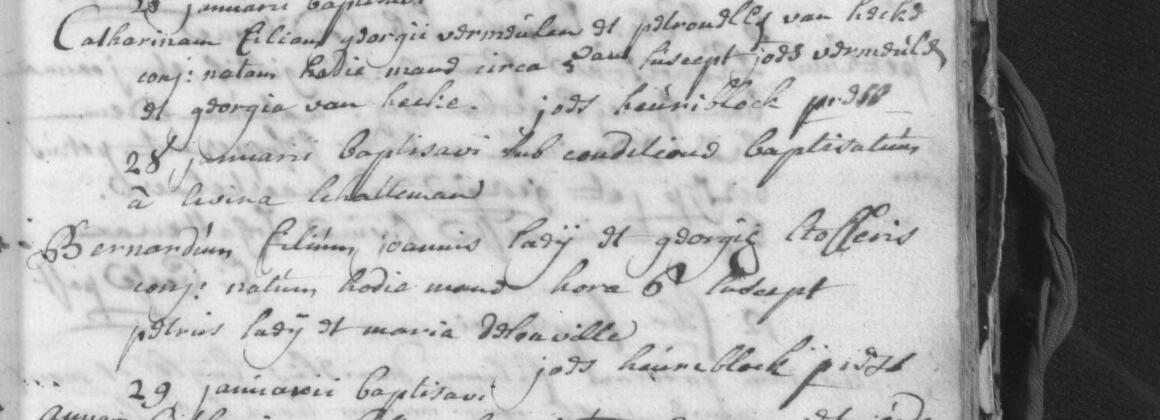
Transcription and translation
28 januarii baptisavi sub conditione baptizatum a Livina Schatteman Bernardum filium Joannis Saey et Georgiae Stoffe[r]s conj. natum hodie mane hora 6. suscept. Petrus Saey et Maria Desonville.
28 January (1748). I conditionally baptised Bernardus, son of Joannes Saey and Georgia Stoffers, spouses, born this morning at six o'clock, already baptised by (the midwife) Livina Schatteman. Godparents: Petrus Saey and Maria Desonville.
Baptisavi sub conditione baptizatum a Livina Schatteman Bernardum filium Joannis Saey et Georgiae Stoffe[r]s conj. natum hodie mane hora 6: "I baptised conditionally, having already been baptised by Livina Schatteman, Bernardus, son of Joannes Saey and Georgia Stoffe[r]s, spouses, born this morning at six o'clock." His godfather was his uncle Petrus Saey, and his godmother Maria Desonville.26 He was given the name of the brother who had died. This Bernardus is the next link in the chain.
Nine months later, in October 1748, the Peace of Aix-la-Chapelle was signed. France agreed to leave the Austrian Netherlands, and Maria Theresa was confirmed as their ruler.21
The Maria Theresa years
Bernardus grew up in the long quiet that followed. Under Maria Theresa, who reigned until 1780, the main roads of the Austrian Netherlands were paved with cobbles and straightened, and the network of roads became far better than it had been.5
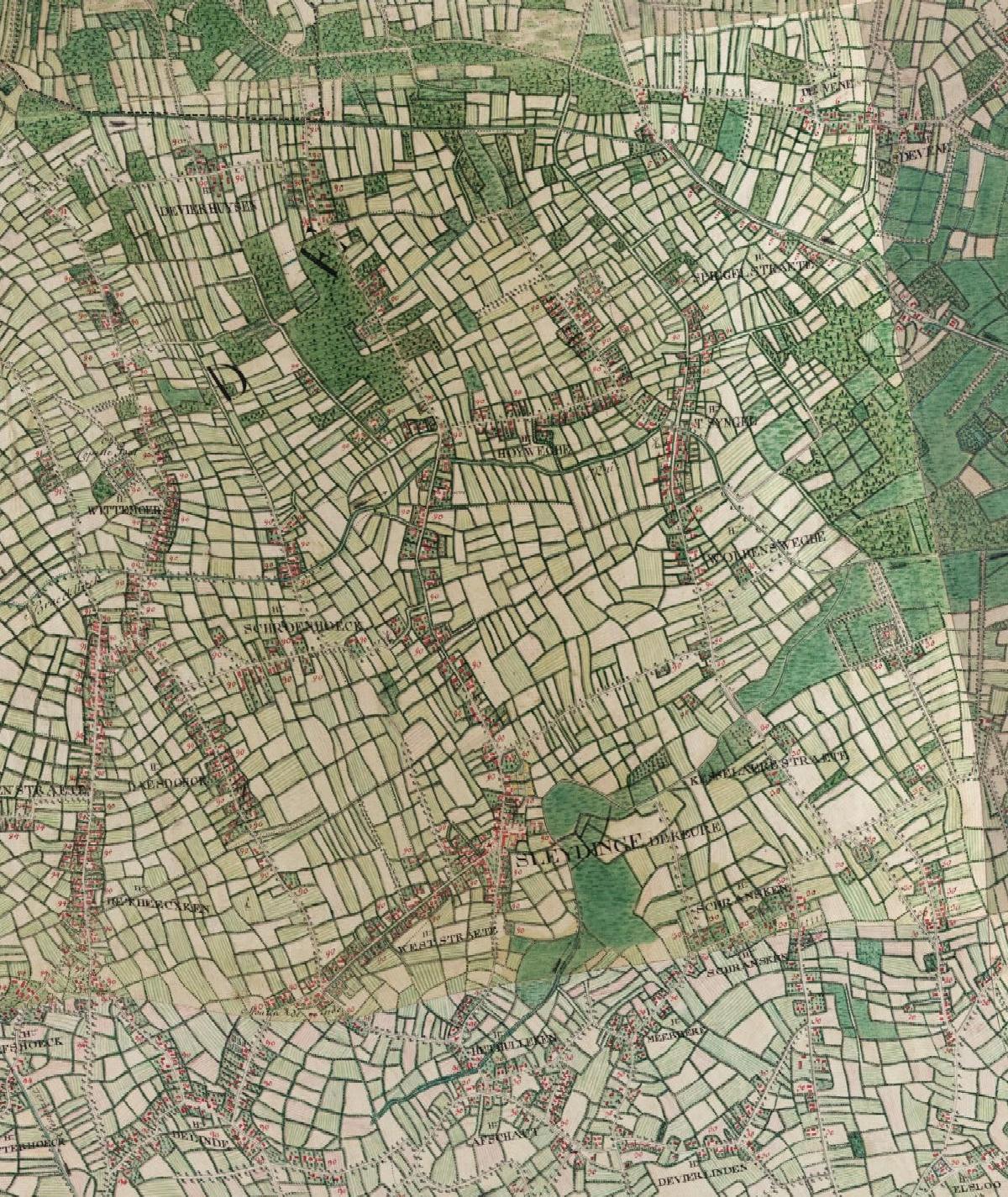
At the end of her reign the country was mapped systematically, and on a large scale, for the first time. The map was made between 1770 and 1778 by Count Joseph de Ferraris, at the request of Prince Charles Alexander of Lorraine, the governor in Brussels, and runs to 275 sheets.27 The sheet for Sleidinge shows the parish as Bernardus knew it as a young father. It is a patchwork of small fields edged with trees, with the houses picked out in red along the roads: the village, the West Straete, the Hoyweghe where his uncle Petrus had lived, and to the north-east the Volpens Weghe.
The family's losses did not stop with the peace. Carolus, the eldest son, died on 15 August 1764, aged twenty-nine. His burial entry names his father and mother, and no wife.28 What became of Cornelius and Joannes Franciscus, the two middle sons, we do not know. Neither appears again in the Sleidinge marriage or burial indexes under any of the spellings we searched, and they may have married or died elsewhere.29
January 1767
Joannes Saey died on Friday 23 January 1767. The priest wrote:

Transcription and translation
23a januarii obiit Joannes Saey f[ilius] Joannis et maritus Georgiae Stofferus aetat. 58 annorum plene administratus
On 23 January (1767) died Joannes Saey, son of Joannes and husband of Georgia Stofferus, aged 58, having received all the sacraments.
23a januarii obiit Joannes Saey f[ilius] Joannis et maritus Georgiae Stofferus aetat. 58 annorum plene administratus: "On 23 January died Joannes Saey, son of Joannes and husband of Georgia Stofferus, aged 58, having received all the sacraments." Plene administratus means that he had been given the last rites: confession, communion and extreme unction. He was in fact sixty; whoever gave his age to the priest was two years out.30
The entry is short, but it matters for this history. By naming his father it ties him to the Joannes who died in 1719, and so to Livinus Saij. Together with the baptism of 1706, it closes the gap between the second and the third generation of the line.31
A second, independent record says the same. Because Bernardus was still under age, the court of Evergem drew up the inventory of his father's estate. It is headed "Jan Saij fs Jan", Jan, son of Jan, who died on the Volpenswege in January 1767. His widow presented it to Francis Saij, Joannes's brother, as co-guardian of "Bernaerdus Saij, 19 years, only child of the deceased".34 Together with the inventory of 1720, which names Joannes as a boy of twelve in the house of Jan Saij fs Lieven, it links the three generations through the same court and the same road.
Georgia
Georgia lived four more years as a widow. On 7 January 1769, in the church at Evergem, her son Bernardus married Maria Anna van Hijfte, a girl from that parish.32 Their first child was born at ten at night on 25 October 1769 and baptised the next day. He was named Joannes, like his late grandfather. His godmother was his grandmother, Georgia Stofferus.33
She did not live to see Bernardus's second child. Georgia died at Sleidinge on 15 December 1770, aged sixty-three, recorded as the daughter of Georgius and the wife of Joannes Saey.12 Three months later Bernardus and Maria Anna had their second child, and they went on to have ten in all. Chapter 6 follows them to Kaprijke. The next chapter goes back to the beginning, to the question the registers of Sleidinge have not yet answered: where Livinus Saij came from.
-
Baptism of Joannes, son of Joannes Zaij and Jacoba Kerkhaert, Sleidinge baptism register 1696–1714, folio 123 [S26]. Read from the original (grade A). The index spells the name "Zay" (record 234769) [S5]. That the godfather was Jacoba's father is an inference from her burial entry, which names her father Joannes [S25] (grade C). The Volpenswege is given as the family's home in the burial entries of January 1706 and October 1708 [S6] (grade B). ↩↩
-
Sleidinge baptism and burial indexes [S5, S6] (grade B); see chapter 2. ↩
-
Burial of Joannes Saey, 5 April 1719 [S4] (grade A); marriage of Cornelius Leuris and Jacoba Kerckaert, 11 June 1722 [S25] (grade B). ↩
-
K. Lanclus and M. Verbeeck, Kantons Evergem en Lochristi, Inventaris Onroerend Erfgoed (1993) [S11]. ↩↩
-
K. Lanclus and M. Verbeeck, Sleidinge, Inventaris Onroerend Erfgoed (1993) [S12]. ↩
-
A. De Vos, Oud Sleidinge (2) [S103] (grade B), quoting De Castillon, about 1722: "ruim 2000 communicanten". ↩
-
N. De Vijlder, The Rural Land Market in Early Modern Inland Flanders and Brabant, Rural History 29 (2018) [S104] (grade B): the population densities from Table 1 (p. 123); the cottars from p. 134; the average transaction from pp. 132-133; the woodland in burghers' hands from p. 133; and, on p. 135, that aspiring farmers "postponed their decisions and worked as day-labourers or farmhands before establishing a household". Note that the article's conclusion (p. 135) gives the rise in cottars as "from 50 to 80 per cent" between the mid-sixteenth and late eighteenth centuries, which does not agree with the 24.8 and 76.26 per cent of p. 134; the dated figures are quoted here. That this describes our own family is our reading, not the article's (grade C). ↩↩
-
Inventaris Onroerend Erfgoed and Wikipedia (Dutch) on Goed ten Broeke and Goed ten Hulle at Wippelgem [S105] (grade B). No record links either manor to this family; they are given as an illustration only. ↩
-
Betrothal and marriage of Joannes Saey and Georgia Stofferus, Sleidinge marriage register 1682–1763, folio 16 [S27]. Read from the original (grade A). The dates of the banns are written in the margin and given in the index (record 244345) [S7]. The days of the week are calculated (grade C). ↩
-
Sleidinge burial index, 15 December 1770: "Georgia Stopheris, father Georgius, partner Saey Joannes, 63 years" (record 251150) [S6] (grade B). Her year of birth, about 1707, is derived from it (grade C). ↩↩
-
Sleidinge baptism index, searched for Stofferis, Stofferus and Stopheris as mother's name and as surname [S5, S34]: Stofferis mothers from 1621 on; children named Georgius or Georgia Stofferis baptised in 1636, 1657 and 1664. ↩
-
Sleidinge baptism index, 6 February 1735 (Carolus, record 231343), 21 February 1737 (Cornelius, record 231038) and 5 December 1742 (Bernardus, record 230260), with the godparents [S5] (grade B). ↩↩↩
-
Baptisms of the children of Joannes Van De Veire and Joanna Stofferis: Petrus Franciscus, 7 October 1734; Judocus, 7 February 1737, "godfather Saey Joannes"; and four more to 1747 [S34] (grade B). Joanna Stofferis was the daughter of a Joannes, not of Georgius, so she was not Georgia's sister [S34]. That she was the godmother of 1735 is an inference (grade C). ↩
-
Marriage of Livinus Saey and Joanna Lippens, 2 March 1737, "witness Saeij Joannes" [S7] (grade B). ↩
-
Sleidinge baptism index, 26 April 1739: "emergency baptism during the birth by Boelens Petronilla; godfather Van De Veire Joannes, godmother Kerckaert Jacoba" (record 230717) [S5] (grade B). The index does not call her a midwife. ↩
-
Baptisms of Joanna Maria (1745) and Joanna (1748), children of Petrus Saey and Livina Teirlinck, "godmother Saey Joanna" and "Saeys Joanna" [S5] (grade B). The identification with Joanna, born 1708, is a guess (grade C at best). ↩
-
Burial of Jacoba Kerckaert, 12 July 1743 [S25]; burial of Bernardus Say, 2 August 1744, "18 months, Volpenswege" (record 254052) [S6] (grade B). The Volpenswege appears in the family's burial entries from 1688 to 1744 [S6]. ↩
-
Burials of Anna Maria Van De Wattyne (1742) and of Petrus's children Franciscus (1741), Joannes Baptista (1744) and Joanna Maria (1747), with the Hooiwege as residence in 1741–1744; baptism of Joannes Franciscus, son of Petrus, 27 October 1744, "godfather Saey Joannes" [S5, S6] (grade B). Two of these entries cannot both be right: a Joannes Baptista, son of Petrus and Livina Teirlinck, buried on 3 October 1744 aged five weeks, and Joannes Franciscus, born to the same couple on 27 October 1744. One of the index entries, or the register, has an error. That this godfather was Petrus's brother is an inference: no other adult Joannes Saey appears in the parish at the time (grade C). ↩
-
National Army Museum, War of the Austrian Succession [S31]. ↩↩↩
-
Sleidinge burial index, 13 June 1746: "Cornelius Leuris, father Gabriel, widower Saey Jacoba, 64 years" (record 253845) [S6] (grade B). Whether the register itself says "Saey" or the indexer supplied it we have not checked. ↩
-
Emergency baptisms "by Schatteman Livina" during the births of Franciscus, son of Petrus Saey, 21 March 1741, and of Bernardus, 28 January 1748 [S5] (grade B). The index does not call her a midwife; that she was one is an inference (grade C). ↩
-
Baptism of Bernardus, Sleidinge baptism register 1739–1758, folio 125 [S35]. Read from the original (grade A). That the godfather Petrus was Joannes's brother is an inference: no other adult Petrus Saey appears in the parish at the time (grade C). ↩
-
Ferraris map, Wikipedia [S29]; the map itself from the Flemish historical-maps service [S20]. ↩
-
Sleidinge burial index, 15 August 1764: "Carolus Saey, father Joannes, mother Stofferus Georgia, 29 years" (record 251900) [S6] (grade B). ↩
-
Searched in the Sleidinge indexes under fourteen spellings of the surname, as person and as partner [S5–S7]. ↩
-
Burial of Joannes Saey, Sleidinge burial register 1764–1792, folio 10 [S28]. Read from the original (grade A). ↩
-
Why the child baptised in 1706 is the man buried in 1767: the burial names his father Joannes; Joannes Saey and Jacoba Kerckaert are the only Say couple with children at Sleidinge between 1700 and 1720, and no second Joannes was born to them, nor did a child Joannes die; his stepfather Cornelius Leuris was witness at his wedding and godfather to his son, his mother godmother to another son, and his brother Petrus godfather to Bernardus. The one thing that does not fit exactly is the age at death, 58 instead of 60. The estate inventories of 1720 and 1767 (note 31) confirm it, so the identification is now grade B. Working file:
evidence/image_1706_baptism.md. ↩ -
Evergem marriages 1751-1782, page 246, read from the image [S88] (grade A): betrothed 26 December 1768, married 7 January 1769. "Uit Evergem" from the baptism index, 17 August 1777 [S5] (grade B). See chapter 6. ↩
-
Sleidinge baptism index, 26 October 1769: "Joannes Saey, father Bernardus, mother Joanna Maria Van Hyfte; godfather Van Hyfte Joannes Baptista, godmother Stofferus Georgia" (record 226434) [S5] (grade B). ↩
-
Estate inventory of Jan Saij fs Jan, died Sleidinge-Sint-Baafs, Volpenswege, January 1767, dated 1 July 1767: L. Neyt, De staten van goed van het Graafschap Evergem, vol. II, no. 387 [S79] (grade B). The abstract calls the widow "Joosijntjen Stofferis fa Jan"; Bernardus's death act of 1809 also calls his mother Jossine. Inventory of 1720: vol. IV, no. 1 [S79]. ↩